Children at play– under the supervision of the playground monitor– in New York’s Seward Park, the city’s first municipal playground. Photo courtesy New York City Department of Parks and Recreation.
A friend posted Megan McArdle’s Bloomberg article “Seven Reasons We Hate Free-Range Parenting” on my Facebook feed today, and as I wrote my comments, it quickly became apparent that my response was just far too long for a Facebook comment. So I’m putting it here. This isn’t meant to be especially thought out or carefully researched, but since the topic overlaps somewhat with some areas of my research, I felt it might be worthwhile to share my scattered thoughts.
I think that “reasons” 3 and 7– about women’s move to the workplace and increasing national wealth– are especially compelling. Along with number 7’s unspoken converse of sorts– “many of us are wealthier, but the haves and have-nots are getting farther apart.”
The free-range parenting being so idyllically recalled, we must remember, is the result of a specific historical moment– the mid-twentieth century, when income disparity was at a historic low.
If we look to the Gilded Age, it’s a different story, as urban children were heavily supervised either by parents or domestics– or they were working themselves. Rural children often enjoyed a greater degree of freedom, but they were often bound to the farm, part of the production model of their family.
In the late 19th and early 20th century, as the middle class and merchants were beginning to move to streetcar suburbs and immigration was at an historic high, the playground movement began in cities like NYC as a response to the number of tenement children unsupervised in the streets, raising themselves. Middle class reformers began calling for playgrounds– which at the time included indoor spaces as well as outdoor and were strictly monitored and supervised by Playground Attendants. The idea was that too many working class kids were out on the streets, and we need to pin them in and supervise them… For their own good, of course.
As America cut off immigration after WWI and began to homogenize economically, the idea of supervising playground play began to lose favor. It is the children of the Depression through the early 1980s who remember fondly a sprawling world of urban and suburban play and childhood that often included interacting with children of different backgrounds, class, etc.
The new age of helicopter parenting coincides with a growth in economic disparity, which creates more clashes over what McArdle describes as “generally accepted child-rearing practices.” Class disparity usually leads to schisms in “generally accepted behavior.” People facing different concerns, different worries, and different economic realities usually don’t agree on everything. Disparity in income brings about conflicts about acceptable behavior.
Wealthier parents supervise more closely, because they can afford to, and because of the pressures McArdle discusses to build a good college application. Poorer parents are forced to cut corners, perhaps give less supervision. For middle-class and wealthy parents, the world is more and more filled with danger, in the form of creeping poverty— something that is very real as the middle class shrinks.
With our cultural gospel of a college degree as the path to the middle class, more privileged parents look more and more carefully at other parents’ choices in child rearing, as they don’t want their children’s friends to hold them back. The parenting practices of the working class and poor are held under ever-higher scrutiny, and when their choices are not like those of parents of more means, those parents are less likely to be sympathetic, because they fundamentally don’t understand the economic reality poorer families face.
Parenting practices are often cyclical, like so many other things, and the pendulum continues to swing. But if the last thirty years seems like the world getting more and more out of whack, that might be because the pendulum has been thrown wildly out of its regular back and forth motion by a rise in income disparity unlike any since the Progressive Era.
In April, the Society of Illustrators held the annual MOCCA Arts Festival, which I was lucky enough to speak at. They recorded it, and put it up on the web. So I thought I’d share it here in case anyone’s interested.
“Sometimes we can coax these immigrants who come to us to dance and sing; but very rarely. They soon get shamed out of their cunning, and join our hosts of patrons who seek relief from monotonous toil in the dime show and the saloon, the “yellow” newspaper and magazine. Yes, it is we, with our over-commercialized life—commercialized drama and opera, commercialized book production and story-making—who have carried farthest this strangling of the arts of the folk. It is we through whom these participants in a living folk-culture sink to the lowest estate as passive patrons of our tawdry and tainted shows.
“No doubt the causes are complex. I shall not attempt an enumeration, but will limit myself to the consequences of the increasing vogue of the book, the mortal tyranny of print. I return, then, to my text that the book is killing the sensuous beauty and emotional appeal of literature. The book lies between us and the essentials of literary beauty. It lies between us and vital literary education. We read our lyrics and our stories, but we don’t sing them and recite them. We cannot even imagine tunes for them as we read—for those lovely lyrical overflows which flood Shakespeare’s plays with melody, for those songs of Burns, for those remaining folk-songs and ballads which are finding cold storage in our anthologies. They are gone with the crooning and lilting of our forefathers, with the singing games of childhood, with the great festivals of the folk.”
–From “The Blight of Literary Bookishness,” (1914) by Percival Chubb, Anti-Comics Crusader
This New Republic article on universities adopting policies that professors adopt “trigger warning” policies before material that may be potentially upsetting started a really interesting discussion among some of my friends on Facebook, and as I struggled with exactly what makes me so uncomfortable with this sort of policy, I realized that this might deserve a little more long-form discussion than Facebook really allows for.
Of course, there is nothing inherently wrong with a professor warning before students encounter material that may be upsetting. I’d certainly argue that it could well be considered common courtesy, and could easily be included in a list of best practices. Giving people an opportunity to brace themselves before encountering distressing material can be helpful. But there is a wide gap between a recommended practice and an institutional policy. By endorsing “trigger warned syllabi” as a matter of policy, universities open themselves up to attacks for making people uncomfortable– which I would argue is inherently part of what higher education is supposed to do.
Tressie McMillan Cottom has written an (unsurprisingly) brilliant piece about this problematic situation: as she puts it,
…the ‘student-customer’ movement is the soft power arm of the neo-liberal corporatization of higher education. No one should ever be uncomfortable because students do not pay to feel things like confusion or anger. That sounds very rational until we consider how the student-customer model doesn’t silence power so much as it stifles any discourse about how power acts on people.
I think this is a very astute observation, and accurate. I think that “trigger warnings” on syllabi are likely to suppress resistance to dominant/oppressive discourses. But I’d like to push into the issue a bit more, specifically from the point of view of a historian.
I would argue that the things that are deemed worthy of trigger warnings are the very stuff of history. Rape, genocide, racism, oppression, enslavement, violence, terrorism, death, destruction… Without the ability to discuss these issues, and to do so openly and honestly, the work of history, and especially of a history professor, is essentially pointless. And adopting a policy that opens one up to reprimand or worse if one should forget to give a “trigger warning” each time you touch on these issues will do nothing but stifle and suppress professors from the important work of teaching their students about history.
When I, as a graduate student, consider a list of dream courses that I would love to teach: a historical survey through the lens of whiteness studies, a course on racial images in early 20th century American media, a class dealing with the lives of Black Americans in the North between 1880 and 1930… any of these classes would need a trigger warning over pretty much the entire syllabus. You might as well just write “Trigger Warning: History Ahead” at the top of the syllabus and be done with it. I literally cannot imagine a single session of these classes going on without a trigger warning proceeding the class, as the very material being discussed throughout is by nature inherently upsetting and problematic.
This goes beyond simple concerns about teaching controversial topics, however. Part of what I find most problematic about such policies is that they would make instructors nervous about using some of the most powerful teaching tools they have.
A lot of the language around what needs a trigger warning deal with issues of verisimilitude. The Geek Girl Wiki advises to give trigger warnings especially when descriptions are “graphic” or “extensive,” as well as “depictions, especially lengthy or psychologically realistic ones” of upsetting events or the psychological effects thereof. Likewise, a student statement opposing a piece of public sculpture at Wellesley made a point of singling out verisimilitude as part of what makes the sculpture objectionable: “The highly lifelike sculpture has become a source of apprehension, fear, and triggering thoughts regarding sexual assault for some members of our campus community.” (Emphasis mine.)
It is precisely this correlation between what is most similar to reality and what is most triggering that makes me supremely leery of institutional trigger warning requirements. Because if you talk to people who are not historians but have really been affected by a history class or a history teacher, it is often that class or instructor exposed them to primary sources and accounts that are among the most triggering things possible: lynching photos, accounts of holocaust survivors, slave narratives, etc…
Alison Landsberg, in Prosthetic Memory, discusses how in public history, exhibits can be designed in such a way to help create “prosthetic memories,” to “produce empathy and social responsibility as well as political alliances that transcend race, class, and gender.” These primary sources, properly contextualized in a classroom environment, can have the same effect: exposure to others’ traumas can encourage empathy and social responsibility, can make us see things beyond the limitations of our own identities, ideologies, and subject positions.
I would like to reiterate, again, that there is never anything wrong with warning people that class material might get a little difficult, that you might be exposed to problematic, upsetting, or triggering materials. But a policy that requires such disclosure in advance of every potentially triggering situation could have a chilling effect on the History classroom, and in such an environment, the materials that would be most likely to be avoided would be precisely the stuff that serves to create these empathetic connections.
Of course, empathy is the very reason we issue a trigger warning in the first place. And that’s why verisimilitude is so problematic. But– I almost hate to say it– I am much more worried about a whole classroom not being exposed to the object, to them not having the opportunity for that moment of empathy, than one student’s legitimate pain at that moment of empathetic self-identification.
Not because that student’s pain is not important, not because we shouldn’t be sensitive to it, but because if we create rules and policies around it, if we start standardizing how we handle these things, instructors will be less comfortable using them as teaching tools. And frankly, I feel that students are helped more at the end of the day by an environment where more people are likely to be empathetic and understanding of their experiences than they are by a school that never unsettles their feelings.
So yes, feel free to give trigger warnings to your classes if the upcoming material might be difficult. It may well mean the world to someone, and it’s not difficult to do. Continue to be empathetic to your students, to encourage them to talk to you one on one or in class, and to work with them if they have issues regarding materials in the course. But please, let’s not make policy out of it. It just doesn’t seem the tactic for building a more empathetic, better tomorrow.
“Of all the festering abominations, away with the Sunday newspaper. It is an imp of Hell and a child of the Devil… because it is a hodge-podge of lie, gossip, twaddle, and caricature. It ruins our Sundays, corrupts our morals, poisons our children and gives us head-aches.”
I’m trying to dig in to Herbert Crowley, and find a bit more about him. Please, if anyone has any ideas or suggestions, fire away!
Dan Nadel has of course found a good bit of information. As has John Adcock. What I’ve been able to find so far has not been much, but hopefully it will be of help to somebody.
I’ve been to the Archives of American Art, and have scans of the letters in the Herbert Crowley Papers, but unfortunately, I’m not sure how much use they will be to anyone. They’re undated, and all to his mother, and definitely hard to read. Frankly, they present both a paleographic problem and more than that, a comprehension problem. Crowley’s language reflects other letters that are unseen, and he is often quite cryptic:
My dear mother–
Your card came to me this afternoon. Am glad to hear that you all got down safely. I envy you– but what can I do? My mind is such a state that even a moment away from that drawing board nigh maddens me & the hours I spend at it maddens me more. There is no let up– when it is done what will it mean to me– nothing! So there we are. I have purchased a Welsbach mantle and I am going to work at night– I must– the whole [int book?] is so absolutely dun-colored that I only get a chance to forget whilst at it…
On a brighter note, I’ve found a couple more news items.This one, from the Sun, is another on the show with Bakst, but unlike the New York Times article that Adcock cites, it has a bit more information. Not much new, but confirming other sources. After all, in the Cartoon Magazine article that Adcock found, the reporter seems to have thought that Crowley was Canadian, rather than English. Getting multiple confirmations of basic facts seems useful. (Although the same article does bring up the enticing possibility that he did work for the Toronto World as late as 1915… I need to ILL that, because I’m excited about the potential that it might even be another comic strip like the Wigglemuch.) I’ve also found a few pertinent facts in “Alice Lewisohn a London Bride,” from the Times, again, this time December 6, 1924:
News has been received here of the marriage of Miss Alice Lewisohn of this city to Herbert E Crowley, the artist, in London yesterday. The ceremony was very quiet and witnessed by only a few friends. Miss Lewisohn, who is the daughter of the late Leonard Lewisohn, was accompanied by her sister, Mis Irene Lewisohn, when she left to visit Europe last Summer. She is also a sister of Lady Howard, Fred Lewisohn and Mrs. Martin Vogel. She told none of her friends of the possibility that she might be married before she returned, but they were not surprised at the news, for she and Mr. Crowely had been close friends for several years.
Mr. Crowley, who is an English artist, has spent much time in this country. The Misses Alice and Irene Lewsiohn were the founders of the Neighborhood Playhouse in Grand Street and have for many years been associated with the Henry Street Settlement. They make their home at 133 West Eleventh Street.
…So I’m posting this for two reasons: one, to help out others who may be interested in researching Crowley, and two, to ask for help. I know there are other researchers interested: if you have any resources I have not mentioned, please, let me know!
“For some hours of the day practically the entire population of the Republic disappears under something in the nature of sixty thousand tons of woodpulp to the accompaniment of a noisy if not positively sanguinary struggle between Susie and Junior as to which has prior right to Mutt and Jeff.”
Bart Beaty’s recent book, Comics Versus Art, is a fascinating account of the relationship between comics and the fine arts, told through a series of case studies from the middle of the twentieth century to the present, from Roy Lichtenstein’s appropriation of comics images to the critical acceptance of literary cartoonists like Chris Ware.
Beaty views the historical relationship between comics and art as antagonistic, as the books title implies. Moreover, it is mutually antagonistic. Art critics have contended that “the aesthetic and artistic issues raised by other forms are totally alien to comics, which exist on an entirely different plane,” while cartoonists and others in the comics world, as a product of a sort of Nietzschean ressentiment, have taken comics’ status as “anti-art” as a point of pride. “Largely ignored by critics and art historians, and consequently disdainful of the interests of those groups, comics have long revelled in their lowbrow, bad boy image.” (19)
Perhaps the most interesting part of the book, and the part that I feel will have the most lasting impact on the theory and historiography of comics, is the second chapter, “What If Comics Were Art? Defining a Comics Art World.” This chapter represents a much-needed intervention into one of the most important debates in comics theory: the attempt to define what constitutes “comics.” Beaty subverts the trend by most comics historians and theorists to define comics according to formal characteristics, and in so doing finds a way to bypass that debate and simultaneously come to a useful definition of “comics.”
While even early chroniclers of comics like Coulton Waugh and Martin Sheridan have attempted formal definitions of comics based on their common conventions and traits, it has been an escalating debate in comics scholarship for around thirty years. In the 1970s, Bill Blackbeard began staking out a definition that was very much historically tied to the advent of the newspaper comic strip, while Will Eisner tried for a more catholic definition, coining the term “sequential art.” Cartoonist Jerry Robinson and art historian David Kunzle extended the definition even further, tracing the lineage of comics to 19th century Bilderbogen, the Bayeux Tapestry and, in Robinson’s case, even cave paintings.
Scott McCloud tackles the difficult problem of defining comics.
Scott McCloud put the question of a formal definition of comics at the center of his seminal 1994 book Understanding Comics, and from that point on, it has been almost a given that any piece of scholarship on comics would include a section on the definition of comics, tracing the advantages and disadvantages of other writer’s interpretations. Theorists such as Greg Hayman and Thierry Groensteen have done much to advance McCloud’s definition and push it further.
However, formalist definitions of comics are inherently problematic. No matter how well-formulated, they tend to exclude works that most readers would automatically describe as comics, and include others that most people would not. McCloud’s definition above, for example, might seem to embrace William Gray’s “Dick and Jane” children’s books, while excluding Gary Larson’s The Far Side.
Rather than attempt a definition of comics linked to formal characteristics, Beaty looks to the idea of institutionalism and “art worlds” in the sociological work on art by Howard Becker, George Dickie, and Arthur Danto. Beaty treats comics as one of many “art worlds,” social networks that create, consume, and otherwise participate in the production of artistic meaning and value. In the world of fine arts, this would include museum curators, artists, art dealers, art collectors, critics, the art press, etc. For comics, this would include editors, collectors, cartoonists, publishers, comic shop owners, and the like.
With this understanding of a “comics world,” formal definitions of what makes something “comics” are unnecessary. “Comics” is simply a term applied to certain items by people within this network, this comics world. The meaning of “comics” is based on a consensus of opinion among a diverse cohort of groups that are invested in the term. It’s a powerful challenge to the formalist debates because it lets us look at the common formal elements as a code, as a set of conventions about comics that creators have shared, agreed upon, and even challenged over the years.
However, for a book that attempts to interrogate “the specific historical and social processes that have led to the devaluation of comics as a cultural form,”(7) Beaty’s periodization is curious. He begins in medias res, in the 1950s, when Fredric Wertham was already testifying to the Senate about the evils of comic books, and Lichtenstein already felt free to appropriate the mechanically-reproduced images from comics uncredited, without regard for provenance or authorship.
In short, he begins at a time when historical forces have already devalued comics as a cultural form. This allows the book to have a narrative grace, a triumphalist arc wherein the art world of comics goes from a place of relative abjection to gradually, and reluctantly come to be more and more accepted within the world of “high art,” and the institutions that undergird that world– universities, galleries, museums, and auction houses.
While this does make for a strong narrative– and I hope I don’t sound like I’m diminishing what I feel is an excellent book– it misses the chance to explore the complex and fascinating moment I have been discussing in this series of posts, when there was considerably more overlap in America between the “high art world” and the “comics art world,” and when self-appointed defenders of American cultural values were scandalized by the rise in the popularity of the comics supplement at the end of the first decade of the century and then by the European avante-garde at the Armory only a few years later.
That the social networks that form the comics art world and the world of high art might share so many common nodes at this time should not be surprising. A major part of the historiography of the Armory Show– though it is being challenged by some in interesting ways of late– is that American art in the years prior to the show was largely provincial, old fashioned, lacking the sophistication and power of the European avante garde.
This may be true, but it is not coincidental that the Ashcan School– one of the groups who were most pushing a new agenda in American art in those years– did work that was so informed by journalism, and that many of them actually worked as visual journalists and illustrators for newspapers and magazines.
Newspapers in the Gilded Age and Progressive Era– and particularly the “Yellow Press” where newspaper comic strips first appeared– were the site of an aggressive visual modernity and dramatic experimentation. I’m inclined to describe it as “Newspaper Modernism”: photo collage, the promiscuous intermingling of image and text, experiments with transmedia exchange, certain forms of abstraction– to say nothing of the development of the modern language of comics– the metropolitan newspaper was the site of some of the most experimental visual culture in America in the years leading up to the Armory Show.
While much American high art was still stalled out at the Realism of the late nineteenth century, artists had a venue for deeply experimental work that was informed by the same forces of modernity that drove the Modernist avante-garde, and had the added benefit of being able to provide a steady paycheck.
Even the American-born artist Lionel Fenninger, later a key part of the Bauhaus school, contracted with the Chicago Tribune in 1906 to begin a comic strip for their Sunday supplement. While short-lived, his Kin-Der-Kids and Wee Willie Winkie strips for the Tribune were beautiful, innovative, and visually remarkable– and gave Fenninger a paycheck that allowed him to move from Germany to Paris.
In the years between 1913 and the 1950s, when Beaty begins his book, there were a whole host of generational, economic, institutional, and cultural shifts that created the environment of mutual rejection between the comics world and art worlds that he describes. But it interesting to think that there was a time when they were much more intimately linked, when things may have gone a different way.
History is always deeply contingent and multivalent. To ignore a period when things had the potential to have gone differently is always a disservice to our understanding of history. And this is one of the reasons that I think that it’s so important to study this period in the history of comics.
To say that comics, as we know the medium today, is an American artform, is not to deny the form’s antecedents in Europe, or the powerful examples of the form around the globe.
The Blues is an American artform, even if Robert Johnson played an instrument that was invented in Spain, and even if John Mayall and the Blues Breakers were a damned good band.
Walt Kuhn is perhaps even better remembered as a promoter of modern art than he is as an artist, which is understandable given how instrumental he was to the Armory Show of 1913. He helped to organize the 1910 Exhibition of Independent Artists, a predecessor to the Armory Show, and was a founding member and officer of the Association of American Painters and Sculptors, the organization that staged the Armory Show.
While his official title in the organization was “secretary,” Kuhn spent more time in Europe developing the show’s European collection than any other of the exhibit’s organizers. He had a large role in picking many of the most important works in the Armory Show,according to the primary historiography of the event, which greatly privileges the European artists featured.
“Chorus Captain,” Walt Kuhn, 1935
Kuhn’s work as a painter demonstrates some of the same concerns as we see in Luks’s work– many of Kuhn’s best paintings depict deeply quotidian, everyday moments in the lives of circus folk and vaudevillians. His chorus girls seem tired, his clowns refuse to smile, his acrobats lean, trying to steal a moment’s rest. Kuhn seems fascinated by the lived lives of entertainers, the lifeways of those that create mass culture, and in capturing them in ways that are unquestionably artistic and painterly. Luks vacillated as a young man between a life in vaudeville and the life of an artist. Kuhn seems to have had the same twin interests.
Just as Luks had, Kuhn was formally trained in both America and Europe, taking art classes as a young man at the Brooklyn Polytechnic Institute, and later, between 1901 and 1903, at the Académie Colarossi in Paris and the Munich Academy. Both artists also started selling cartoons to magazines and illustrating for newspapers in the 1890s.
While Kuhn’s career as a newspaper cartoonist is even less widely-remembered than Luks’s, it was longer lived. According to Philip Rhys Adams’s biography Walt Kuhn, Painter, Kuhn’s work as a cartoonist was his “financial mainstay” between 1905 and 1914, selling cartoons to humor magazines like Life, Puck, and Judge, as well as to newspapers. (18)
An example of Kuhn’s “Whisk,” 1909-1910, playing with the notion of artistic Realism.
Kuhn also had a run of almost two years (February 1909-October 1910) on a strip called “Whisk” that was distributed by the New York World, examples of which can be found in the San Francisco Call from that period via Chronicling America.
After that, Kuhn had a weekly panel in the Brooklyn Eagle called “Funny Birds” that ran from April through December of 1912, before being taken over by Bob Addams; Kuhn was in Europe assembling art for the Armory Show as early as 11 November, and was likely too busy with that to continue the strip. Nevertheless, these two strips mean that Kuhn’s career as a newspaper comic strip cartoonist lasted longer than the approximately 50 “Hogan’s Alley” strips that Luks published.
Left to right: George O. Hart, Walt Kuhn, and Gus Mager at the Jersey Shore, circa 1915.
Moreover, Kuhn seems to have been better at making and maintaining friendships and allies within the world of newspapers and cartoonists as well as the art world. Kuhn was a close friend of many in the news world, including cartoonists like Gus Mager (mentioned in Part 2 of this series) and men like James Gibbons Huneker, the New York Sun‘s Music, Drama, and Art editor from 1900 to 1912. (Adams, 29.) This ability to bridge the art world and the world of newspapers may account for both the high representation of cartoonists in the Armory Show as well as Kuhn’s role, once the show began to ramp up, as its chief promoter and press officer.
“The Latest in Easter Eggs,” by Louis M. Glackens, “Puck,” March 1913
Which brings me back again, as at the beginning of this series of posts, to the question of how to interpret the reactions of cartoonists to the Armory Show. Should we interpret the jabs at cubism as an outright rejection of the artform by an American public not yet ready for abstraction? Or are they something more playful, more polysemic, more complex? Louis Glackens’s “The Latest in Easter Eggs,” a cartoon from the cover of Puck in 1913, is another example, like “The Rude Descending a Staircase” in Part 1, that is frequently used to illustrate middle class Americans’ scandalized attitude toward the exhibit.
While the ridiculousness of a hen laying cubist eggs is obvious– and fairly comical– and the hen’s face reflects an amusing pompousness, I would still argue that it is deeply reductive to read this cartoon as a simple mocking of the artists of the Armory Show, or an outright rejection of modernity, abstraction, etc.
One reason that I would argue this is that the cartoonist, Louis Glackens, was the brother of the Ashcan School’s William Glackens, who exhibited in the Armory Show. While Kuhn would have a falling out with Robert Henri during the planning of the exhibit, in part because Henri wanted to handle his own press coverage, according to Adams, “William and Edith Glackens were lifelong friends of both Walt and Vera Kuhn,” (42) and Glackens, who had attended the first meeting of the Association of American Painters and Sculptors along with Kuhn and others, was an integral part of the planning of the Armory Show, including the selection of some of the European modernist works.
While it is not inconceivable that the brothers Glackens didn’t see eye-to-eye when it came to the merits of cubism and abstraction, I believe that there’s another reason to believe that this cartoon may not be the simple reflection of public reaction that it is sometimes represented as: the trope of birds in a barnyard setting seems to be a leitmotif in many of Walt Kuhn’s cartoons.
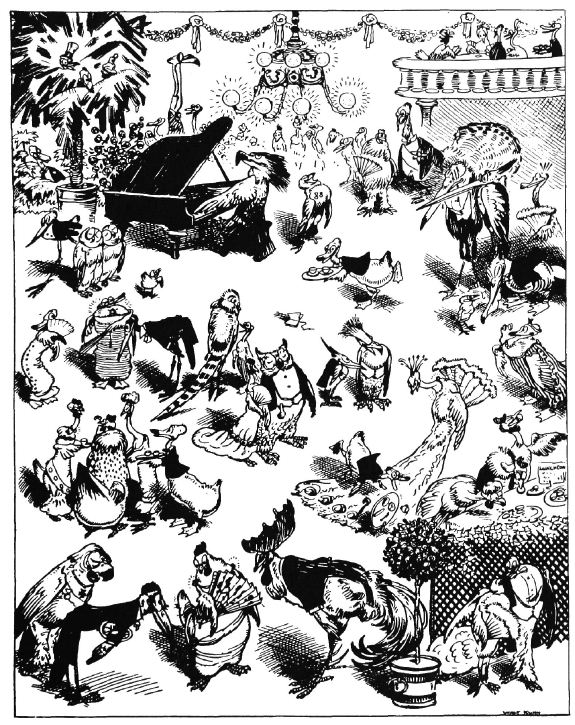
“Barnyard Reasoning,” by Walt Kuhn, appeared in a 1907 issue of “Judge”“Mr. and Mrs. Barnyard-Fowl Give a Reception,” Walt Kuhn, 1912
The magazine cartoons here certainly point to the frequent use of birds in barnyards, and many example of Kuhn’s cartoon work that I have been able to find involve birds, barnyards, or both– usually to contrast and gently mock urban pretentions, fads, and foibles. This is certainly not a genre of magazine cartoon that is limited to Kuhn, but it seems to be a common thread running through much of his cartoon work– and Kuhn is quite adept at drawing birds, anthropomorphizing them in a trademark style that skates along the line between naturalistic and bigfoot cartooning. I want to go to the Library of Congress soon to look through their Brooklyn Eagle microfilms for 1912, as I have a strong suspicion that his run on “Funny Birds” is more of the same.
To me, it seems likely that this Puck cover, while it played to a public still unsure what to make of cubism, was also a playful jab at a fellow cartoonist and family friend, as well.
When I see cartoons like this that poke fun at cubism in the period around 1913, many of them seem to be just as much about the cartoonist’s enjoyment of playing with (and playing at) all the forms that these new “isms” took. The butt of the joke may be the High Art of Europe, but I often see a winking enjoyment, a playfulness and enjoyment of experimentation. And it is important to keep in mind that Walt Kuhn was drawing cartoons about birds in the barnyard to support himself even as he helped to organize the Armory Show– and these cartoons betray a real enjoyment of cartoon and caricature, even if it may seem incompatible with his tastes for cubism, fauvism, futurism, and the like.
The artistic mind is vast, it contains multitudes. Kuhn, like his friends “Pop” Hart and William Glackens, appreciated, enjoyed, and celebrated the new modernity of European painting, even if each of these artists’ work was relatively conservative by comparison to the European avante-garde.
There were different expressions of modernity happening in America in the years leading up to the Armory Show– artists had different outlets for their experimentation, and there was real experimentation happening, though much of it wasn’t in the fine arts. And that leads me to the topic of the next and final post in this series.