Categories
Uncategorized

The Cartoonist as Artist, Part 3

Cartoonists in the Armory Show, 2: George Luks

"Street Scene (Hester Street)" George Luks, 1905
“Street Scene (Hester Street)” George Luks, 1905

George Luks is remembered primarily for his work as a painter, and particularly for his involvement in the Ashcan School and as a member of “The Eight.” However, a recent monograph on the artist by Robert Gambone makes a powerful case for the need to see Luks’s work as a commercial illustrator as central to his ouvre: “Rather than forming a preliminary or preparatory footnote to his more well known and successful career as a painter, the journal, book, and newspaper graphics of George B. Luks remain important precisely because they constitute a prime locus where he developed and worked out attitudes and ideas that shaped his entire career…” (Gambone, xiii)

"The Spielers" George Luks, 1905
“The Spielers” George Luks, 1905

Indeed, the biographical portrait of Luks that Gambone lays out in the first one is fascinating, as he seems to have been a man quite uninfluenced by the bifurcation of American Culture that was at its apex early in his career. As a young man, Luks and his brother formed a blackface minstrel act, “Buzzy and Anstock,” touring low-class urban theaters. Luks then broke up the act a year later upon enrolling in the storied Pennsylvania Academy of Fine Arts. Luks left the academy after a short stint there, and resumed the minstrel act.  The act ceased touring again when Luks left for Germany to study at the Kunstakademie Düsseldorf, where he again remained only a matter of months.

In 1890, when Monet began a public campaign to purchase Manet’s Olympia for the state of France to exhibit, the cartoonist was in Paris studying informally at museums, and would have been very aware of the ensuing bruhaha that came after Monet’s public letter about the matter in La Figaro. (Gambone, 11-12) If only the most elite American artists were exposed to modernism before the 1913 Armory Show, people like the former minstrel, multiple art academy drop-out, and  newspaper cartoonist George Luks was among this “elite.”

Luks began doing cartoons for the magazines Puck and Truth in the 1890s. As Gambone points out, magazines were middle-brow and middle-class, and may have well been seen as an entree into respectable art by the young Luks. Indeed, top cartoonists like Thomas Nast and Puck owner Joseph Keppler were commanding quite a lot for their works, and Nast was supplementing this by working the lecture circuit describing how he had gone tête a bête, as it were, against Boss Tweed. In my own research, I was shocked at how widely and vehemently Keppler was on his death in 1895, memorialized from newspapers to literary magazines– surprising to someone has seen the unceremonious five-line obits of some of the most pioneering (but forgotten) early comic strip artists.
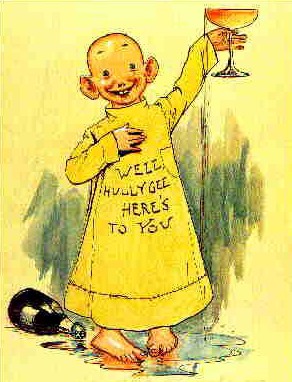
Outcault's Yellow Kid
Outcault’s Yellow Kid

Mickey Dougan, The Yellow Kid, was a character created by cartoonist Richard Felton Outcault, and Outcault is often described by many as the first newspaper comic strip cartoonist. The character appeared first in magazine cartoons, and later made the move into the Sunday color supplement of Pulitzer’s New York World in 1895. The color cartoons centered around the Kid and the other denizens of the tenement neighborhood of Hogan’s Alley. Anarchic, madcap, and sometimes violent, the strip was the first time that cartoons demonstrably drove newspaper sales, and the Yellow Kid was used to merchandise everything from dolls and chewing gum to stage plays. This was something new, something big, and Pulitzer saw that the newspaper’s comic insert could be an important too for driving sales.

A George Luks "Hogan's Alley" page, 18 October 1896
A George Luks “Hogan’s Alley” page, 18 October 1896

This happened in the midst of the famous rivalry between Pulitzer and William Randolph Hearst, and Hearst was not content to let Pulitzer’s success go unpunished. Offering more money, Hearst hired Outcault out from under Pulitzer, and began publishing Yellow Kid strips in the New York Journal. Pulitzer, believing he had a claim on the character’s copyright, hired Luks– already an artist on the World staff– to begin drawing new Yellow Kid strips. A court case resulted, and the ultimate finding was that Outcault could continue to use the character as it was his creation, but the strip’s title, Hogan’s Alley, belonged to the World. Both papers continued to run strips featuring the character under different names.

Luks’s willingness to take over Outcault’s duties on Hogan’s Alley was apparently not well received by others in the World bullpin. Theater critic Louis Sobol would recall, second-hand, an interaction between Luks  and a former coworker years later in his memoir The Longest Street. Sobol recalled a story told by producer John Golden, who had been in the World art department with Luks after Outcault’s departure:

“Well, William Randolph Hearst came along and coaxed Outcault to bring ‘Yellow Kid’ over to the Journal. Whereupon Joe Pulitzer, irked by this theft of one of his artists, had a certain newcomer imitate the strip, and for quite a while we had two ‘Yellow Kids’ running. Everybody in the business considered this highly unethical, and in fact many of the boys stopped talking to the young imitator artist.

“The years passed, and I became a producer. One day my secretary came in and said there was a man outside to see me, and, of course, as you must guess, it was the ostracized cartoonist. By this time, I wasn’t as peeved with him as I had been in those earlier days, so I told the girl to show him in.

“He said: ‘Look here, John Golden, you don’t have to be so high-hat with me. I don’t do any silly cartoons anymore. I move around with the best of them. I paint kings and queens, and I get more for a single painting than I did for a whole year’s cartooning. So don’t be so stuck up with me. I’m just as important as you are.'”

Golden went on to tell us that indeed the fellow had become as important as he claimed. He was George B. Luks whose paint­ings were hung in national museums around the world, and whom James Huneker once described as “a Puck, a Caliban, a Falstaff, a tornado.” (Sobol, 408)

While second-hand, the story rings true in terms of Luks’s cantankerous personality as well as his ambition. It is also made more believable by the fact that, even to this day, Luks is often given short mention or even not named in many accounts of the battle over the Yellow Kid, while Outcault is put at center stage. To me, this story has the ring of someone who was deeply hurt by exclusion by the social network of artists with whom he was, at that time, in daily contact. He seems to have seen his relative success as a fine artist as a comeuppance to that exclusion– an attitude that might suggest that, even while he had more acceptance in the world of fine arts, he saw the commercial work he did as related, contiguous, if not equivalent.


The Cartoonist as Artist:

Categories
Uncategorized

Book House Nancy

As part of the Powerpoint Unhinged challenge at THATCamp CHNM 2013, Matt Gold, Zach Coble and myself put together a presentation/performance based on a title by Matt Gold, “Book House: DH Publishing as Living Space.” It was a fun little experiment in performance in the deformative humanities.

This was my slideshow.

Book House Nancy from Tad Suiter
Categories
Uncategorized

The Cartoonist as Artist, Part 2

Cartoonists in the Armory Show

In my previous post I argued that cartoonists’ reactions to the Armory show may have been born as much out of sympathy for and interest in the formal experimentation of the more revolutionary European modernists represented in the show, and that it seems possible to me that these cartoonists may have “seen themselves as within the broader orbit of the art world, in one way or another.”

This interpretation is reinforced further by the fact that there were actually several newspaper cartoonists who participated in the Armory show– who were actually among the artists shown at the Exposition. A site created for the University of Virginia’s American Studies program lists four newspaper cartoonists in the show, each of whom had worked on multiple recurrent newspaper comics features: Rudolph Dirks, Denys Wortman, Marjorie Organ, and Gus Mager. These artist each deserve at least a moment’s individual attention, as it’s quite an impressive list.


Fledglings by Rudolph Dirks
“Fledglings” by Rudolph Dirks, 1908. Not (to my knowledge) the painting shown by Dirks at the Armory Show, but of approximately the same time period. From the collection of the Smithsonian Air and Space Museum.

Rudolph Dirks was the cartoonist who created The Katzenjammer Kids, one of the earliest strips to take the form of the comic strip as modern readers would likely define it: it used sequential panels,  word balloons, and had– at times– narrative continuity from strip to strip. Dirks is given a lot of credit as one of the most innovative creators of what became the standard graphic lexicon of comics.

In 1913, his work as a cartoonist would have been by far the most recognizable to New York audiences of all the cartoonists participating in the Exhibition. The Katzenjammer Kids still runs in a handfull of papers today, syndicated by King Features, making it by far the longest-running comic strip in history.

The wording of the UVA website is a little confusing, but it looks as if Dirks may have had two paintings at the Armory show, in galleries N and E.


Denys Wortman, "Bermuda Waterfront," 1912.
Denys Wortman, “Bermuda Waterfront,” 1912, displayed in the Armory Show of 1913.

Denys Wortman was, until recently, a largely forgotten cartoonist, though he was remembered by fellow cartoonist  Coulton Waugh in his 1947 book The Comics as “of all newspaper drawings, perhaps the most artistic.” (p.168) Fortunately, with the publication of a recent collection of his work, as well as an exhibit of his work at the Museum of the City of New York, Wortman’s work is beginning to get the credit and remembrance it deserves.

There is a remarkable continuity between Wortman’s paintings and his single panel cartoon feature, Metropolitan Movies.  He was a genre painter and a genre cartoonist: in both cases, his work is imbued with the same feeling of quickly-sketched but masterfully rendered moments from everyday life. Looking at his paintings, his sketches, and his published cartoons, one quickly comes to feel that they were all very much part of the same project for the artist.


Marjorie Organ, "Robert Henri in Bed"
Marjorie Organ, “Robert Henri in Bed”

Marjorie Organ is by far the most obscure of the four cartoonists under discussion, which is unfortunate. She seems to have been the first woman to have a recurring comic feature in a newspaper, Little Reggie and the Heavenly Twins, which began running in 1902, when Organ was only 16. Six years later, she met the artist Robert Henri, one of the leading figures of the Ashcan School and “The Eight,” and they were married soon after, retiring almost immediately from newspaper work to focus on her family and her art.

Organ seems to have been relegated to obscurity for several reasons. Her work is not without merit, but she was certainly a journeyman among that first generation of newspaper comic strip artists, and she did not have the chance to mature due to her early retirement. She also suffered the misfortune of being a woman, and a quite attractive one at that– she is perhaps best remembered today as a subject of portraiture by her husband, especially in his painting Lady in Black with Spanish Scarf. She seems to be one of a long line of female artists who were overshadowed in a patriarchal society by their more-successful artist spouse.


Gus Mager, Self Portrait
Gus Mager, Self Portrait, 1914

Finally, Gus Mager was one of the first cartoonists to have a recurring strip in the black and white dailies, as well as an accomplished artist. Mager had begun as a comic strip cartoonist with his Monks series, a somewhat idiosyncratic and crudely (though expressively) drawn strip featuring a whole procession of different “monk” characters– anthropomorphic monkeys with names like Knocko the Monk, Sherlocko the Monk, Groucho the Monk, etc. In 1913, he had just begun a run in the New York World with his new strip, Hawkshaw the Detective, a humanized adaptation of his “Sherlocko the Monk” character. As a painter, one sees little of the crude simple lines of Mager’s early comic strips. His works are painterly, expressive, and comparatively quite complex.

The story of how the collection was built for the Armory Show is largely an account of the social networks that made up the art world in the US and Europe in the Progressive Era, and Mager apears to be an important member of that network and to why he and other cartoonists were included in the Exhibition– he seems to have been friends with Armory Show organizer Walt Kuhn, and served as an assistant to Dirks.

From the evidence available, it seems Mager viewed himself as existing in both the world of newspapermen and cartoonists as well as the art world. An article about Mager in the American Magazine of Art from 1916 by artist and critic Guy Pène du Bois emphasizes Mager as an artist of merit, while treating his work in newspapers as a trial overcome. Nevertheless, Mager continued at it for quite some time, and Hawkshaw alone ran until the 1950s.

"Monks" cartoon by Gus Mager, 1910
“Monks” cartoon by Gus Mager, 1910

These newspaper comic strip cartoonists participating in the Armory show points to their own belief that they were not apart from the art world, but of it. Other Armory Show participants did illustration work for papers and magazines, like George Bellows and John French Sloan, and there are two other cartoonists omitted from the UVA site that are particularly important— and those two cartoonists will be the subject of the next posts in this series.


Edited To Add, 14 June 2013: 

It has come to my attention from this article that one other strip cartoonist was in the Armory Show that I had not been aware of: the largely-forgotten cartoonist Herbert Crowley, one of the cartoonists rediscovered by Dan Nadel in his book Art Out of Time. Little is known about Crowley, but Nadel describes his work beautifully:

There has never been a comic strip that treated its two component parts– writing and drawing– as strangely as Crowley’s. The action unfolds in panoramic panels populated by expressionless characters that resemble artfully designed pewter toys set on a stage. The backgrounds are meticulously crosshatched, making the characters seem all the more unreal and removed from the environment…

The Wiggle Much is really just barely a comic– its glacial pacing, lack of any formal ingredients, and separation of text and image make it tough to qualify. But, like Gustave Verbeek, Crowley accomplished a vision in newsprint that could only have snuck into print under the guise of a comic strip, at a time when the medium was first finding its feet.

The Crowley pieces in the above-linked article indicate that Crowley was a man of a unique and singular vision, and one who could hardly be lumped in with the image of American artists in the Armory show as conservative and traditional. Rather, his work looks more contemporary than it looks like something of its own time. If I saw it in a gallery, I would assume it was by a living artist with a Jim Woodring obsession.


"The Wiggle Much," by Crowley
“The Wiggle Much,” by Crowley


The Cartoonist as Artist:

Categories
Uncategorized

The Cartoonist as Artist, Part 1

Working on a dissertation that attempts to put early newspaper comics into their cultural context, I had hoped to avoid the topic of “art” all together. Whenever I come across analyses that depend too much on the canons of high art or literature, I grow suspicious. Even when looking at an especially well-done one, like Thomas Inge’s discussion of George Herriman and Dada in Comics as Culture, it tends to feel, to me, like an exercise in legitimization.

“Here,” these authors seem to say, “I’ll prove that comics have artistic merit. Look how many similarities we can find between this artform and your supposedly legitimate high art!” The old saw about dancing about architecture comes to mind. And as someone who believes that the medium of comics is worthy of appreciation and study on its own merits, there’s just something distasteful about trying to borrow cultural capital to legitimate the medium.

That said, historical research can often seem to develop its own agendas, independent of the researcher. And that seems to be the case with my dissertation. While I had hoped to avoid discussing art history and high modernism, I find that multiple threads of my research keep tying back to that topic. And I’ve decided to give in.


Cartoonists View the Armory Show

One of the sites of entanglement, the things I keep coming back to in spite of my own desire to leave the topic alone, is The International Exhibition of Modern Art in 1913, better known as the Armory Show, remembered as the first large exhibit to bring Modernism to the attention of a wide American audience.

Duchamp's Nude Decending a StaircaseTwo paintings perhaps best represent what was so revolutionary about the Armory Show, and dominated much of the uproar that followed the Exhibition’s opening: Duchamp’s Nu descendant un escalier n° 2, and Matisse’s Luxury.

Looking at Duchamp’s painting, we see an artist who is actually working on a very similar project to many cartoonists of the time: both are struggling to create a new visual language that can communicate them in a static medium, and the influence of Muybridge’s experiments with motion and photography can be seen in each. Duchamp, like contemporary cartoonists, is trying to show movement over time and through space in the picture plane.

The Rude Decending a Staircase
The Rude Decending a Staircase (Rush Hour at the Subway), from the New York Evening Sun, 20 March 1913.

Many cultural critics and comics historians have cited various cartoonists’ parodies and pastiches of Duchamp as visual evidence of the culture’s unease with modernism. These commenters do the cartoonists a disservice, I think, in viewing them as merely cultural observers, and not as artists themselves. In fact, most of the members of the first generation of newspaper comic strip cartoonists had fine arts training from art institutes and colleges.

Moreover, I think that viewing these cartoons as merely an expression of the public discomfort with, or confusion at, modern art overlooks the similarities of their projects. I would argue that many of these cartoonists did see themselves as artists, or at the least as people engaged in the greater art world, conversant with trends in the states and abroad. They may have seen the similarities between Duchamp’s futuristic cubism, with its abstraction and focus on movement, and their own work. They are likely to even be quite sympathetic to claims about the immorality, crudeness, or lack of merit of modern art, as these claims were echoes of a largely-forgotten social panic about newspaper comics that began around 1908 and lasted until approximately 1912.

LuxuryMoving on to Matisse’s Luxury, which was another flashpoint work in the exhibit, though less of a lightning rod than Duchamp’s Nude. Again, we can see an aesthetic similarity between the modern artist and the cartoonist. Matisse’s use of (relatively) flat colors, dark outlines around objects (especially in the foreground), and figures that are equally built from anatomy, symbolic representation, and an aesthetically chosen line (be it aesthetically pleasing or off-putting) are all in certain ways  similar to the type of art that appeared in the Sunday comic supplements of the urban papers at that time.  Images like this were probably far less shocking to cartoonists than to most of the public that came to the Armory show. Alfred Stieglitz had been exhibiting European modernists in smaller galleries, including Matisse, since at least 1905. While the Armory Show drew the broader public to the new guard of European artists, it would be unsurprising if many of these professional illustrators, many of them young men who had fairly recently trained in art schools, would have been among the patrons who attended these galleries. 

Simply put, it is harder to imagine that many cartoonists saw themselves as disconnected from the world of fine art than it is to imagine that they might have seen themselves as within the broader orbit of the art world, in one way or another. It is likely that many of them frequented galleries, met artists, and were part of the world of fine arts while also working as cartoonists for newspapers.


The Cartoonist as Artist:

Categories
Uncategorized

Scott McCloud and Digital Comics

Scott McCloud, perhaps the most important living formalist analyst of comics, has been one of the most vocal advocates of the transformative potential of online comics. But the most popular and successful online comics have, for the most part, been strips– comics that emulate the oldest form of modern comics. McCloud is certainly not wrong– online comics have the potential to take the medium to a whole different level, one that has been only hinted at in the work of Jason Shiga, McCloud, and others. But the fact that strips have really made up the majority of the digital comics success stories really points to the longevity of the strip format.

Categories
Uncategorized

Murdered Over Comics?

I’m really not sure what to make of this article I found in the December 21, 1903 issue of the Chicago Daily Tribune. There was a bit of a moral panic about comic supplements in the end of that decade, but I haven’t found much this early to explain what was going on here.

Is this just an example of the bloody tastes of the yellow press? This story is certainly gruesome, but what other anxieties or concerns about urban life did it touch upon? Murders happen every day in a big city. It’s the ones that touch on broader concerns that grab media attention.

Trigger Warning: this article contains some pretty graphic discussion of domestic violence and murder. Despite the date, this is not an April Fools’ Day post. 


KILLS WIFE AND SELF

Fred Pflugradt Also Attempts to Shoot Baby 8 Days Old.

TROUBLE DUE TO A PAPER

Neighbor Beats at Door While Husband Commits Crimes.

A quarrel over the possession of the comic supplement of a Sunday newspaper led yesterday morning to the murder of Mrs. Elizabeth Pflugradt by her husband, Frederick Pflugradt, who afterward committed suicide by shooting. The husband also attempted to slay their only child, a boy 8 days old, whom he had torn from the mother’s arms.

The tragedy occurred in the rooms of the couple above their hardware store at 7039 Halsted street, and while the husband was committing his double crime a neighbor was beating frantically upon the locked door of the bedroom In which the wife was lying, while a sister of Mrs. Pflugradt was running in search of a policeman.

Both Want Comic Section.

The paper was delivered at 8:30 o’clock and Miss Kate Cloudy, the sister who was attending the woman, took it to Mrs. Pflugradt. who was clasping the child In her arms. Mrs. Pflugradt kept only the comic section and asked that the rest be taken to her husband. The man entered the room a few minutes later. Holding the baby toward her husband, Mrs. Pflugradt said:

“Fred, you have not kissed our baby this morning.”

Ignoring her words, the man replied gruffly:

“Give me the ‘funny part’ of that paper.”

Miss Cloudy begged that the mother be allowed to keep it. The mother made the same request, and the baby, frightened by angry words, joined the quarrel by crying. The Infant angered Pflugradt, who ordered his sister-in-law to leave the room.

Begins to Beat His Wife.

Locking the door when Miss Cloudy had gone, the young husband snatched away the paper and then threw it on the floor.

“I’ll teach you to oppose me,” he was heard to say. Then came a cry of pain and the sound of a descending strap wielded by the husband. The mother, her babe torn from her arms, was dragged from the bed and beaten. Her cries of pain alarmed Mrs. Mary Blake, who lived next door.

While Mrs. Blake stood in the sitting room, helpless, Miss Cloudy ran to Sixty-ninth street to find a policeman. What happened before her return is told by Mrs. Blake, as follows:

“For five minutes I pounded on the door. Then I ran to the window to get aid from passersby, but none appeared. I returned to my post near the bedroom, and suddenly heard Mrs. Pflugradt cry:

“‘O, Fred, what are you doing? Think of our child! Would you kill Its mother?'”

Neighbor Hears Pistol Shots.

The answer was a pistol snot, A cry followed and then all was still, except for the crying of the baby. Then came another shot, and a third. The husband fell to the floor.

“At that moment a policeman came. He burst open the door. Kate fell fainting. Beside the bed lay the body of her sister. Close by was that of the husband. Mrs. Pflugradt had been shot through the heart and the man had placed the pistol In his mouth. •

“The baby had been thrown to the foot of the bed, and an inch above its head was a bullet hole in the wall.”

Pflugradt was 28 years old and his wife was two years younger. They were married two years ago and bought the hardware store a year ago. Mrs. Pflugradt acted as clerk In the store daily during the absence of her husband, who was a machinist and generally was working outside. They parted a year ago, but soon effected a reconciliation.


ETA:
Hat tip to Erin Bush for telling me about the Homicide in Chicago, 1870-1930 database. The curious can find the events described above confirmed at that source, though few additional details are given.
Categories
Uncategorized

M. Thomas Inge, Comics as Culture, pg. 138

…Contrary to popular belief, the comics did not thrive because of the immigrant readers who knew little English. A good command of the language was necessary to get the point of much comic strip humor, especially things like the street urchin dialect of The Yellow Kid or the mock-German dialect of The Katzenjammer Kids.

M. Thomas Inge, Comics as Culture, pg. 138

Categories
Uncategorized

Review: Allan Holtz, American Newspaper Comics: An Encyclopedic Reference Guide

Cover of Holt's "American Newspaper Comics"At $120 on Amazon, Allen Holtz’s 2012 American Newspaper Comics: Am Encyclopedic Reference Guide may well be the most expensive new book I’ve ever purchased. As someone who is working on a dissertation on early newspaper comics, however, it’s an invaluable resource, and worth every penny.
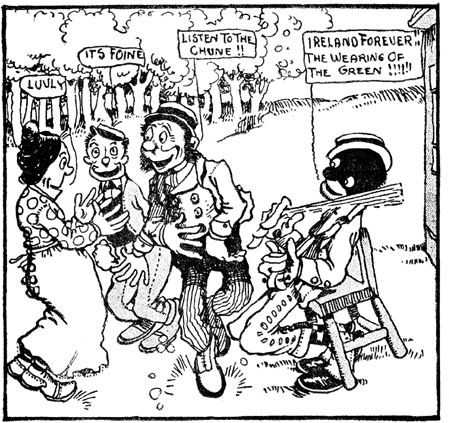
The book is the first of its kind: a well-researched guide to the publishing history of virtually every recurring comic strip or panel to have a run in a general-audience American newspaper, published with the imprimatur of a respected university press. This is no small task, however, and the book has the heft you might imagine: it’s over six hundred 8.5×11″ pages of pure text– that’s right, there are no illustrations. The price of reproducing images would have been prohibitive both in terms of the book’s size (it’s already a bit heavy to carry around) and its price. Instead, over three thousand example illustrations are packaged in a PDF on a CD-Rom that comes with the book.

While six-hundred-plus pages of pure text is not what one might expect from most books on comics, it works well: this is a reference book, straight up, with very little interpretation or editorializing. One doesn’t so much “read” this book, as one uses it. Illustrations, while they would certainly given the book visual appeal, would have only been distracting. It’s best to think of this volume as a database in print form. And thinking of it as such, this book is a pleasure to use.

Let’s say you were interested in finding information about “Musical Mose,” an early, short-lived strip that lampooned the notion of racial “passing” by “Krazy Kat” cartoonist George Herriman– himself a man of African-American decent who was passing, in certain circles, as white. Looking it up alphabetically, it’s on page 281, which takes you from “The Muggles” to “Mutt and Jeff.” Holtz’s approach is minimalist, but highly informative:

4409 • Musical Mose. Sunday strip. Running dates: Feb 16-Feb 23 1902. Creator: George Herriman. Syndicate: New York World. Notes: An earlier untitled strip featuring the same character, but named Sam, appeared on 1/19/1902. Sources: Ken Barker in StripScene #12 except 1/19/02 info from Cole Johnson.

George Herriman's "Musical Mose" was a strip about a black musician who constantly found himself, despite deft musicianship, unable to ingratiate himself to the ethnic immigrant audiences he played to. Herriman was himself of African-American decent.
George Herriman’s “Musical Mose” was a strip about a black musician who constantly found himself, despite deft musicianship, unable to ingratiate himself to the ethnic immigrant audiences he played to. Herriman is believed to himself  have been of African-American decent, and to have “passed” as white.

While we don’t get an exploration of the themes of the strip or how it reflects on Herriman’s own life story, we do get a lot of good data: given that it was a Sunday strip, we know that there are only three known episodes of “Musical Mose,” and have the dates to find them.

We know that the strip was by George Herriman, who fans of old comic strips would immediately associate with “Krazy Kat,” and possibly “The Dingbat Family,” a domestic comedy that “Krazy Kat” began as topper gags to. However, upon flipping to the (somewhat awkwardly titled) “Index of Credits,” the user will find thirty-eight different Herriman titles that can be found in the book, from the wonderfully titled “Major Ozone’s Fresh Air Crusade” to “Mutt and Jeff,” which we learn, flipping back to the entry for that strip, Italian comics historian Alberto Becattini asserts Herriman provided some ghost work and assists on.

Finally, by going to the invaluable “Index of Syndicates,” we can find other strips that ran in Pulitzer’s New York World, and by looking at those, we can find what strips were contemporary with “Mose.” Moving back and forth while exploring various cartoonists’ works, getting a feeling for various features syndicates’ preferred types of strips, etc., an interested researcher can definitely get lost in this book.

Holtz has established his knowledge of the field in his blog, Stripper’s Guide, for years, and the book has special characters next to any strip discussed in the blog, as well as one for strips represented in the illustration CD-ROM. His blog becomes a very valuable supporting resource, with more details about the topics of strips, biographies of cartoonists, and the like. I find myself using this book with my Nexus 7 tablet next to it, as I’m constantly wanting to see what else I can find. (The future of books isn’t e-books, it’s reading with a divice in the other hand…)


While it’s superbly well-researched and a pleasure to use, it is not without problems. Putting all the illustrations on a CD-ROM works well, but putting them all in a single PDF with no labels or metadata makes using the CD-Rom unnecessarily difficult. Holtz’s choosing to only include comics from general audience newspapers makes sense on one hand, as small trade papers and other marginal newspapers are not as well-documented or well-preserved, and had lower readership.

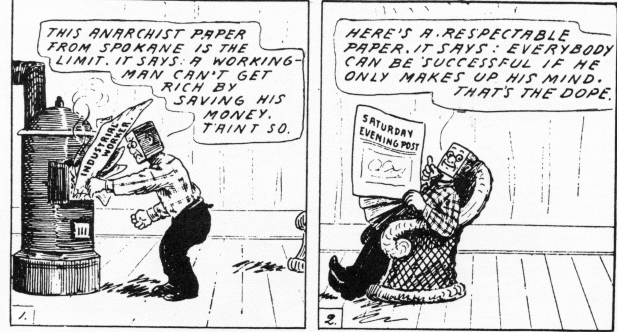
Mr Block was an anarcho-syndicalist IWW strip, where the eponymous main character represented the "block-headedness" of politically moderate AFL and CIO workers. Strips like these reached out to workers while making specific cultural claims about what was "common sense."
Mr Block was an anarcho-syndicalist IWW strip, where the eponymous main character represented the “block-headedness” of politically moderate AFL and CIO workers. Strips like these reached out to workers while making specific cultural claims about what was “common sense.”

However, the use of comic strips was an important way for more marginal presses like foreign langage newspapers and labor papers to try to integrate themselves into the mainstream. While the Spokane Industrial Worker wasn’t necessarily a mainstream paper, it was doing something specific by including the Mr. Block cartoons, and the book feels the poorer for their absence. (And one could argue that the Joe Hill song by the same name points to the strips cultural relevance, even if it was a limited-audience relevance.)

My biggest critique of the book isn’t so much a problem with the Holtz’s book itself as the inherent limitations of books generally. Books have some great qualities: they have long shelf lives, they’re not dependent on changing technical specifications, they can work with only ambient solar power (in other words, you can stand by a window and read), and they’re just generally extremely stable. And this is all good– indeed, I’m quite glad that this research was published in book form, as the research in it will be useful for scholars for years. However, this is all ongoing research. There are people– the author included– still constantly scouring old newspapers and microfilm for new finds.

Holtz has been working online for years now, and he is very open to the post-publication peer review that the internet does so well. In fact, at the end of the book’s conclusion, he includes his email address and mailing address, in case readers should have corrections, comments, feedback. And this trait makes me trust Holtz as a researcher. But unless this volume goes into multiple revised volumes over the years, oversights are going to be permanent.

Here’s one example that also points to the shortcomings of a physical book: Holtz was alerted to at least one more Musical Mose strip last year, clearly after the book had gone into editorial review but (I believe) before it was published. While on the internet an author can share this discovery with their audience and the record is improved, there’s no post-publication corrections for a physical book.

Is this a glaring inaccuracy in the book? No. It’s a single oversight, a single strip missed. There will inevitably be problems like this in any reference book so exhaustive. But it’s not nothing, either. This is a very early strip, thematically very important to some key biographical questions about the author– and George Herriman is one of the most universally artistically acclaimed newspaper comic artists in history. If Holtz’s blog ever goes down, some key information might be lost.

Again, I’m glad that this information was published as a book. I grew up reading comics collections and comics history reference guides at my local public library– that was one of the things that got me so interested in studying history. Libraries and comics researchers should definitely purchase this volume– no book is ever perfect, but this one is amazingly well-done. However, having said that, I can’t help but hope that the University of Michigan Press will see its way to producing a second, electronic volume of this book, one that could be periodically updated and available to research libraries and other institutions for a one-time fee or an affordable subscription rate. More scans of strips could be made available, especially early work that’s in the public domain. Holtz’s “Strippers Guide” columns could be linked within, as well as other bloggers or writers that he and the editorial staff might feel could contribute.

This is possibly the best reference book on comics history I have ever encountered, but an online comics reference database could do so many things that the book cannot.

Categories
Uncategorized

Tom De Haven, Funny Papers, p. 139

A man and a woman were arguing loudly as Walter skated past Violin Park, and glancing at them, he thought, Big noses on the two of them—his hat’s too small. And he could almost hear Georgie asking him, But how are their noses different, Walter? What kind of hat is it? Look, Walter, look. It was ever so difficult, though, for Walter to do that, to look with such scrutiny. A face or a building, a crowd or a streetcar, a decorated Christmas tree, whatever it was that he happened to see, Walter would remark only its most striking features; the finer points of a thing hardly ever made an impression on him. He would see a man’s bald dome and heavy chest, never the man’s cuff links—unless they were diamond and sparkled. His father, the eye specialist, probably would’ve called it a form of myopia, but Walter, as as he’d already told Georgie, called it vision and deemed it a gift. He saw things simplified.

–Tom De Haven, Funny Papers, p. 139


Categories
Uncategorized

Notes on the Death of the Postscript

On Monday, I had the pleasure of being contacted somewhat out of the blue by the Wall Street Journal’s Katherine Rosman for a piece she was working on, dealing with the decline of the Postscript (P.S.) in the age of the email.

Rosman’s piece is great, and I highly recommend checking it out. It’s well-written, fun, and quick– and obviously very well-researched. Some of the examples she pulls out are just brilliant.

As is often the case when someone who has spent too much time immersed in the world of academia is interviewed for the media, however, it only contained a bit of the long-ranging (and one-sided and probably overly-long) conversation that we had during the interview. This is an inevitability, not in any way a criticism.

If anything, it’s a positive comment on Rosman’s discernment and ability to mill down into a whole lot of rambling academic geekery to get a nugget of substance out of it.

However, since I’ve neglected this blog for far too long, I thought it might be fun to put up the notes I typed up in preparation for the interview. Just because I do have more to say on the topic, and I already have it written down.

Those with an interest in communications history will probably note that I am deeply indebted to David Henkin’s The Postal Age, and that I come off far more of a technological determinist than I really should feel comfortable being. These are just some hastily typed up notes, with basicly no editing, but I figure there’s no harm in putting it out there, as I don’t know when I’ll have opportunity to revisit the topic, which I started to find more and more fascinating the more I thought about it in preparation for the interview.


Postscripts date back pretty far– I don’t know how far. The OED has some examples that go back to the 1500s and 1600s. I know that they were not uncommon in the 1700s. I asked a couple early Americanist friends, and there’s good examples from the founding fathers, definitely.

But the postscript as we think of it today probably is more properly dated a little later. It gained wide usage as non-business letters became a wide-spread practice in the 19th century– especially after the postal reforms of 1845 and 1851, which greatly reduced the price of letter mail, thus opening up the postal system to much more personal communication for those not of the highest classes.

Most letters before that were letters of business, and brevity and precision were highly valued. But as more people were writing letters, there became a tradition of epistolatory intimacy– people began to write friends and family that were separated by space in a nation where people were more and more frequently uprooted. This also meant that letters became much more a providence of women. Women had already been key to the ties of sociability that kept culture coherent.

Women were very much associated with PS’s– even (especially?) multiple PS’s, in which most of the real substance of the letter could be found. In old business-like letters, the PS’s were reserved for either afterthoughts or emphatic points– things people wanted to highlight the importance of. This continues in epistolatory intimacy, but the INTIMACY was the most important thing. It makes sense in the context of the time that it would be seen as feminine.

These letters were of a script, formulaic. Most personal letters from the mid-19th century started the same way– “Dearest ____, I have taken a moment to take pen in hand and let you know that I am well, and hope that you are enjoying the same blessing.”

Formulas like this let people know what kind of letter they’re reading. They let the reader orient themselves, and give them a guide to how to interpret. Many people, especially older folks, tend to wish they still had the old letter-writing signposts in emails.

But emails were conceived differently.

They were created for scientific and military communication as much as anything else. For this reason they follow the format of the business memorandum, rather than the personal letter. As they were mass-adopted in the 90s for personal communication, people at first tended to borrow the rhetoric of the personal letter, as it was familiar. But different media are biased to different types of communication– look at the way that Neitzche’s writing changed toward epigraphs as he began working on a typewriter, as Freidrich Kittler points out.

Using email to maintain connection and reinforce social ties has a different shape and feel than letters. In the most obvious sense, immediacy replaces length. It is no longer necessary to ramble on about daily goings-on, and no longer feels un-intimate to write brief communications, because we can email back and forth multiple times in the time that a letter would take to get to the recipient, even though the USPS is the most efficient it has ever been at getting from point a to point b. Immediacy is the new length– I know you care not because your email is long, but because it comes quickly. If I get a fast reply from an email, I know that means we are close. I’ve even heard teachers talking about never responding to emails under a certain amount of time, so that students don’t assume the right to instantaneous communication.

I’m also wondering if the fact that signature lines were always present during the time of email’s mass popularization might have something to do with it, although I’m not sure.

There’s something else, too, about the medium– it’s word-processing, rather than typewriting or manuscript. Even in a brief email like the one I sent you this morning, I edit as I compose. I never send out a first draft– that’s for SMS. Writing is shaped by the tools, and I wonder if this might not be in part the fact that a postscript, an afterthought, seems sloppy or lazy in an email. Find the appropriate place to put it in the body of the email! As someone who was first put in front of a word processor in 1986 or so, while still in elementary school, and whose writing level shot up grade levels almost overnight, I would argue that it’s important not to underestimate the effect of word processing on the writer.

Also, as the internet gives us different ways to correspond, different levels of information become appropriate in our emails. I wouldn’t bore most friends with my doings of late in an email, because most of the people I’m close with would know what i am up to because I show up in their Facebook newsfeed or Twitter feed. Thus this sort of information does less to build bonds, and seems more unnecessary– it switches from signal to noise.

css.php