Scott McCloud, perhaps the most important living formalist analyst of comics, has been one of the most vocal advocates of the transformative potential of online comics. But the most popular and successful online comics have, for the most part, been strips– comics that emulate the oldest form of modern comics. McCloud is certainly not wrong– online comics have the potential to take the medium to a whole different level, one that has been only hinted at in the work of Jason Shiga, McCloud, and others. But the fact that strips have really made up the majority of the digital comics success stories really points to the longevity of the strip format.
I’m really not sure what to make of this article I found in the December 21, 1903 issue of the Chicago Daily Tribune. There was a bit of a moral panic about comic supplements in the end of that decade, but I haven’t found much this early to explain what was going on here.
Is this just an example of the bloody tastes of the yellow press? This story is certainly gruesome, but what other anxieties or concerns about urban life did it touch upon? Murders happen every day in a big city. It’s the ones that touch on broader concerns that grab media attention.
Trigger Warning: this article contains some pretty graphic discussion of domestic violence and murder. Despite the date, this is not an April Fools’ Day post.
KILLS WIFE AND SELF
Fred Pflugradt Also Attempts to Shoot Baby 8 Days Old.
TROUBLE DUE TO A PAPER
Neighbor Beats at Door While Husband Commits Crimes.
A quarrel over the possession of the comic supplement of a Sunday newspaper led yesterday morning to the murder of Mrs. Elizabeth Pflugradt by her husband, Frederick Pflugradt, who afterward committed suicide by shooting. The husband also attempted to slay their only child, a boy 8 days old, whom he had torn from the mother’s arms.
The tragedy occurred in the rooms of the couple above their hardware store at 7039 Halsted street, and while the husband was committing his double crime a neighbor was beating frantically upon the locked door of the bedroom In which the wife was lying, while a sister of Mrs. Pflugradt was running in search of a policeman.
Both Want Comic Section.
The paper was delivered at 8:30 o’clock and Miss Kate Cloudy, the sister who was attending the woman, took it to Mrs. Pflugradt. who was clasping the child In her arms. Mrs. Pflugradt kept only the comic section and asked that the rest be taken to her husband. The man entered the room a few minutes later. Holding the baby toward her husband, Mrs. Pflugradt said:
“Fred, you have not kissed our baby this morning.”
Ignoring her words, the man replied gruffly:
“Give me the ‘funny part’ of that paper.”
Miss Cloudy begged that the mother be allowed to keep it. The mother made the same request, and the baby, frightened by angry words, joined the quarrel by crying. The Infant angered Pflugradt, who ordered his sister-in-law to leave the room.
Begins to Beat His Wife.
Locking the door when Miss Cloudy had gone, the young husband snatched away the paper and then threw it on the floor.
“I’ll teach you to oppose me,” he was heard to say. Then came a cry of pain and the sound of a descending strap wielded by the husband. The mother, her babe torn from her arms, was dragged from the bed and beaten. Her cries of pain alarmed Mrs. Mary Blake, who lived next door.
While Mrs. Blake stood in the sitting room, helpless, Miss Cloudy ran to Sixty-ninth street to find a policeman. What happened before her return is told by Mrs. Blake, as follows:
“For five minutes I pounded on the door. Then I ran to the window to get aid from passersby, but none appeared. I returned to my post near the bedroom, and suddenly heard Mrs. Pflugradt cry:
“‘O, Fred, what are you doing? Think of our child! Would you kill Its mother?'”
Neighbor Hears Pistol Shots.
The answer was a pistol snot, A cry followed and then all was still, except for the crying of the baby. Then came another shot, and a third. The husband fell to the floor.
“At that moment a policeman came. He burst open the door. Kate fell fainting. Beside the bed lay the body of her sister. Close by was that of the husband. Mrs. Pflugradt had been shot through the heart and the man had placed the pistol In his mouth. •
“The baby had been thrown to the foot of the bed, and an inch above its head was a bullet hole in the wall.”
Pflugradt was 28 years old and his wife was two years younger. They were married two years ago and bought the hardware store a year ago. Mrs. Pflugradt acted as clerk In the store daily during the absence of her husband, who was a machinist and generally was working outside. They parted a year ago, but soon effected a reconciliation.
…Contrary to popular belief, the comics did not thrive because of the immigrant readers who knew little English. A good command of the language was necessary to get the point of much comic strip humor, especially things like the street urchin dialect of The Yellow Kid or the mock-German dialect of The Katzenjammer Kids.
At $120 on Amazon, Allen Holtz’s 2012 American Newspaper Comics: Am Encyclopedic Reference Guide may well be the most expensive new book I’ve ever purchased. As someone who is working on a dissertation on early newspaper comics, however, it’s an invaluable resource, and worth every penny.
The book is the first of its kind: a well-researched guide to the publishing history of virtually every recurring comic strip or panel to have a run in a general-audience American newspaper, published with the imprimatur of a respected university press. This is no small task, however, and the book has the heft you might imagine: it’s over six hundred 8.5×11″ pages of pure text– that’s right, there are no illustrations. The price of reproducing images would have been prohibitive both in terms of the book’s size (it’s already a bit heavy to carry around) and its price. Instead, over three thousand example illustrations are packaged in a PDF on a CD-Rom that comes with the book.
While six-hundred-plus pages of pure text is not what one might expect from most books on comics, it works well: this is a reference book, straight up, with very little interpretation or editorializing. One doesn’t so much “read” this book, as one uses it. Illustrations, while they would certainly given the book visual appeal, would have only been distracting. It’s best to think of this volume as a database in print form. And thinking of it as such, this book is a pleasure to use.
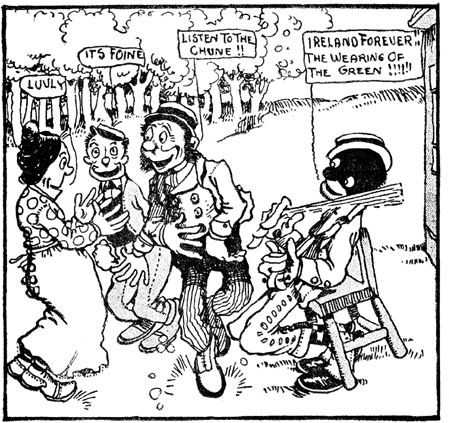
Let’s say you were interested in finding information about “Musical Mose,” an early, short-lived strip that lampooned the notion of racial “passing” by “Krazy Kat” cartoonist George Herriman– himself a man of African-American decent who was passing, in certain circles, as white. Looking it up alphabetically, it’s on page 281, which takes you from “The Muggles” to “Mutt and Jeff.” Holtz’s approach is minimalist, but highly informative:
4409 • Musical Mose. Sunday strip. Running dates: Feb 16-Feb 23 1902. Creator: George Herriman. Syndicate: New York World. Notes: An earlier untitled strip featuring the same character, but named Sam, appeared on 1/19/1902. Sources: Ken Barker in StripScene #12 except 1/19/02 info from Cole Johnson.
George Herriman’s “Musical Mose” was a strip about a black musician who constantly found himself, despite deft musicianship, unable to ingratiate himself to the ethnic immigrant audiences he played to. Herriman is believed to himself have been of African-American decent, and to have “passed” as white.
While we don’t get an exploration of the themes of the strip or how it reflects on Herriman’s own life story, we do get a lot of good data: given that it was a Sunday strip, we know that there are only three known episodes of “Musical Mose,” and have the dates to find them.
We know that the strip was by George Herriman, who fans of old comic strips would immediately associate with “Krazy Kat,” and possibly “The Dingbat Family,” a domestic comedy that “Krazy Kat” began as topper gags to. However, upon flipping to the (somewhat awkwardly titled) “Index of Credits,” the user will find thirty-eight different Herriman titles that can be found in the book, from the wonderfully titled “Major Ozone’s Fresh Air Crusade” to “Mutt and Jeff,” which we learn, flipping back to the entry for that strip, Italian comics historian Alberto Becattini asserts Herriman provided some ghost work and assists on.
Finally, by going to the invaluable “Index of Syndicates,” we can find other strips that ran in Pulitzer’s New York World, and by looking at those, we can find what strips were contemporary with “Mose.” Moving back and forth while exploring various cartoonists’ works, getting a feeling for various features syndicates’ preferred types of strips, etc., an interested researcher can definitely get lost in this book.
Holtz has established his knowledge of the field in his blog, Stripper’s Guide, for years, and the book has special characters next to any strip discussed in the blog, as well as one for strips represented in the illustration CD-ROM. His blog becomes a very valuable supporting resource, with more details about the topics of strips, biographies of cartoonists, and the like. I find myself using this book with my Nexus 7 tablet next to it, as I’m constantly wanting to see what else I can find. (The future of books isn’t e-books, it’s reading with a divice in the other hand…)
While it’s superbly well-researched and a pleasure to use, it is not without problems. Putting all the illustrations on a CD-ROM works well, but putting them all in a single PDF with no labels or metadata makes using the CD-Rom unnecessarily difficult. Holtz’s choosing to only include comics from general audience newspapers makes sense on one hand, as small trade papers and other marginal newspapers are not as well-documented or well-preserved, and had lower readership.
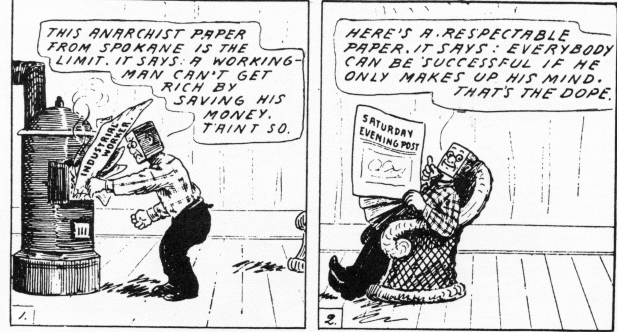
Mr Block was an anarcho-syndicalist IWW strip, where the eponymous main character represented the “block-headedness” of politically moderate AFL and CIO workers. Strips like these reached out to workers while making specific cultural claims about what was “common sense.”
However, the use of comic strips was an important way for more marginal presses like foreign langage newspapers and labor papers to try to integrate themselves into the mainstream. While the Spokane Industrial Worker wasn’t necessarily a mainstream paper, it was doing something specific by including the Mr. Block cartoons, and the book feels the poorer for their absence. (And one could argue that the Joe Hill song by the same name points to the strips cultural relevance, even if it was a limited-audience relevance.)
My biggest critique of the book isn’t so much aproblem with the Holtz’s book itself as the inherent limitations of books generally. Books have some great qualities: they have long shelf lives, they’re not dependent on changing technical specifications, they can work with only ambient solar power (in other words, you can stand by a window and read), and they’re just generally extremely stable. And this is all good– indeed, I’m quite glad that this research was published in book form, as the research in it will be useful for scholars for years. However, this is all ongoing research. There are people– the author included– still constantly scouring old newspapers and microfilm for new finds.
Holtz has been working online for years now, and he is very open to the post-publication peer review that the internet does so well. In fact, at the end of the book’s conclusion, he includes his email address and mailing address, in case readers should have corrections, comments, feedback. And this trait makes me trust Holtz as a researcher. But unless this volume goes into multiple revised volumes over the years, oversights are going to be permanent.
Here’s one example that also points to the shortcomings of a physical book: Holtz was alerted to at least one more Musical Mose strip last year, clearly after the book had gone into editorial review but (I believe) before it was published. While on the internet an author can share this discovery with their audience and the record is improved, there’s no post-publication corrections for a physical book.
Is this a glaring inaccuracy in the book? No. It’s a single oversight, a single strip missed. There will inevitably be problems like this in any reference book so exhaustive. But it’s not nothing, either. This is a very early strip, thematically very important to some key biographical questions about the author– and George Herriman is one of the most universally artistically acclaimed newspaper comic artists in history. If Holtz’s blog ever goes down, some key information might be lost.
Again, I’m glad that this information was published as a book. I grew up reading comics collections and comics history reference guides at my local public library– that was one of the things that got me so interested in studying history. Libraries and comics researchers should definitely purchase this volume– no book is ever perfect, but this one is amazingly well-done. However, having said that, I can’t help but hope that the University of Michigan Press will see its way to producing a second, electronic volume of this book, one that could be periodically updated and available to research libraries and other institutions for a one-time fee or an affordable subscription rate. More scans of strips could be made available, especially early work that’s in the public domain. Holtz’s “Strippers Guide” columns could be linked within, as well as other bloggers or writers that he and the editorial staff might feel could contribute.
This is possibly the best reference book on comics history I have ever encountered, but an online comics reference database could do so many things that the book cannot.
A man and a woman were arguing loudly as Walter skated past Violin Park, and glancing at them, he thought, Big noses on the two of them—his hat’s too small. And he could almost hear Georgie asking him, But how are their noses different, Walter? What kind of hat is it? Look, Walter, look. It was ever so difficult, though, for Walter to do that, to look with such scrutiny. A face or a building, a crowd or a streetcar, a decorated Christmas tree, whatever it was that he happened to see, Walter would remark only its most striking features; the finer points of a thing hardly ever made an impression on him. He would see a man’s bald dome and heavy chest, never the man’s cuff links—unless they were diamond and sparkled. His father, the eye specialist, probably would’ve called it a form of myopia, but Walter, as as he’d already told Georgie, called it vision and deemed it a gift. He saw things simplified.
 At $120 on Amazon, Allen Holtz’s 2012 American Newspaper Comics: Am Encyclopedic Reference Guide may well be the most expensive new book I’ve ever purchased. As someone who is working on a dissertation on early newspaper comics, however, it’s an invaluable resource, and worth every penny.