Categories
Uncategorized

Taking the simple and making it sublime…

Because nothing encourages learning like actually doing, each student in HIST 389: the History of Animation is required to produce a short animation.

Now, a lot of students are probably going to want to do a zoetrope or another persistence-of-vision toy, because it seems like the most accessible, simple technique. There’s no software or camera concerns– it seems like something a kid could do:

But just because the basic principle is simple doesn’t mean that the application of the principle needs to be simplistic. The following film uses the basic zoetrope technology to create something really powerful and beautiful.

(Watch it in hi res for maximum effect.)

>

Animator Eric Dyer, of Baltimore, spent a period of time biking around the city of Copenhagen, shooting things he saw. He then took the images and built a series of zoetrope-type devices using them. Finally, he filmed the results.

Here’s what his set-up looked like:

I think the project is amazing, both just because it’s visually beautiful and moving, and because it is such a fascinating reinterpretation of an old technology. In the below interview he describes his next project as involving hand-painted objects designed on a computer and printed out using a 3-D printer, and finally animated using the zoetrope technique. It’s a fascinating idea that, if it’s executed as well as “The Copenhagen Cycles,” will likely be stunning to see.

Categories
Uncategorized

Defining Digital Storytelling…

My Digital Storytelling class was asked to try to define “digital storytelling.” Below is my reply.

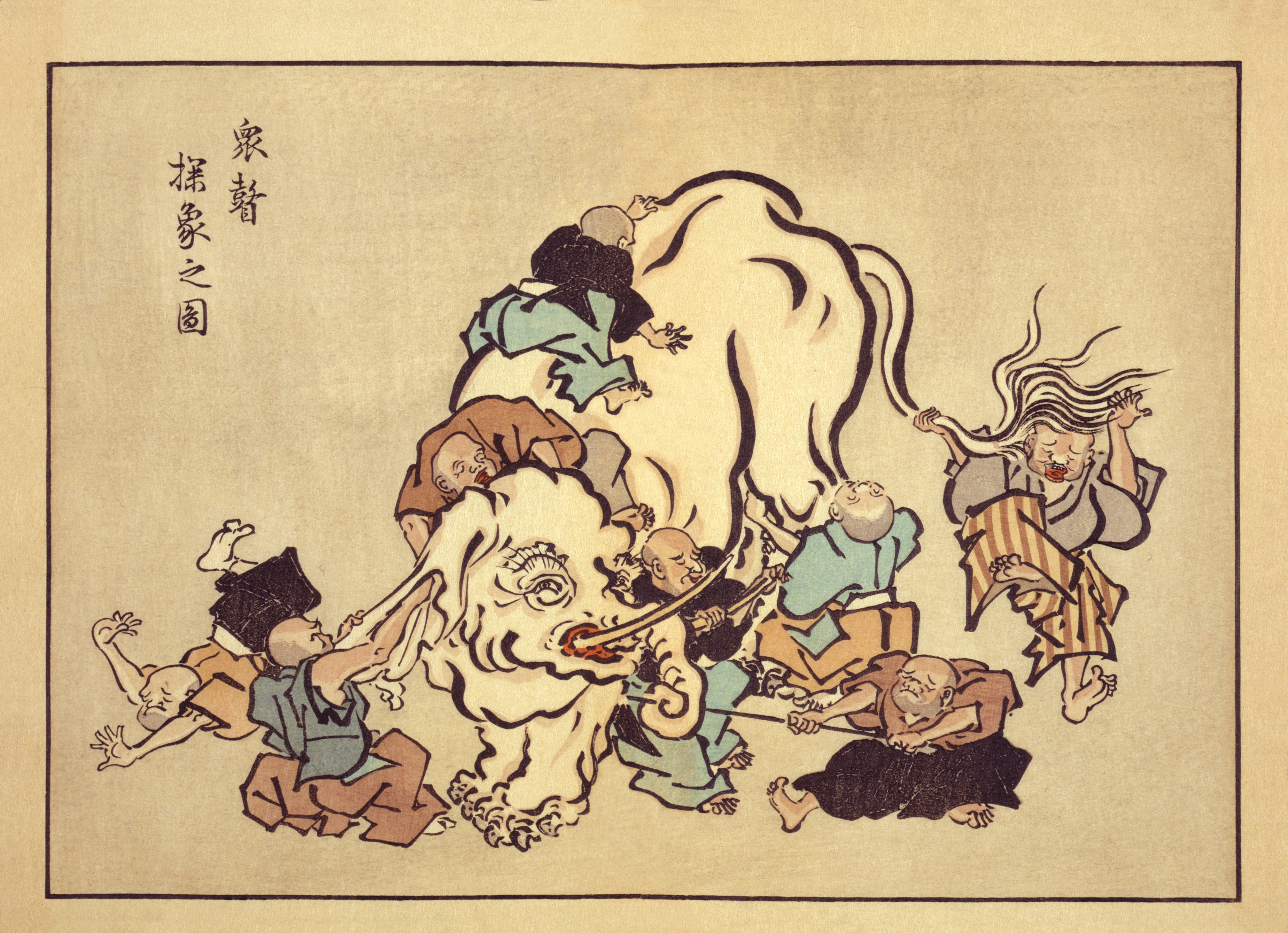
It seems to me like we’ve got one of those blind-men-and-an-elephant problems, here. I’ve been playing around with trying to come up with a working definition of “digital storytelling” for a couple days, now, and honestly, anything I can come up with is simultaneously:

  • So broad as to be meaningless.
  • Still far too restrictive.

This does not bode well for the prospect of coming up with anything that even resembles a “definitive answer” to the question of what “digital storytelling” is.

Which makes this class seem a bit amorphous.

The best I can come with is this: “Digital storytelling” is the use of digital (non-analog, usually computer-based) media to create (or suggest) a narrative (or set of narratives or narrative possibilities).

I could unpack that a little, but I’m afraid to do so too much, because the more you do, the more restrictive your definition becomes. So let me just sort of ramble about a couple of the implications of this.


The use of digital techniques alters older technologies by lowering barriers to use in both cost and necessity of technical skill. While techniques like sophisticated 3-d rendering are still prohibitively difficult for amateur users, digital photography, videography, sound recording, and image alteration have continued to get cheaper, faster, and easier. Looking at a the technological forces behind this, things like Moore’s Law, Rock’s Law, and Nielson’s Law all suggest that this pattern will continue. All things digital will continue to get faster, cheaper, easier, and better, as long as research and development continue.

Not only is this true with individual digitized media, but it is also true of the ability of computers to integrate various forms of media into a coherent whole. Digital technology continues to make it easier, faster, and cheaper to put together still and moving images, sounds, and written words, to combine them into new integrated wholes.

And just like the words and pictures of a comic strip, each of these elements gains something in combination with other elements– it’s a synergistic relationship. Looking at just the words or just the images of your average comic strip, you realize that either element is less meaningful when not interacting with the other. The whole is more than the sum of the parts. It’s the same thing with digital stories that incorporate multiple media.


While words, pictures, sound, and video are all clearly important building blocks for digital stories, it is important not to exclude the “natively digital” media that can be incorporated into digital storytelling projects– the two that spring immediately to mind are simulation and databases.

Both of these technologies present us with some of the most dramatic possibilities of digital storytelling: they do not necessarily follow– and indeed can be used to actively undermine– the traditional notions of narrativity we have from old media. Storytelling is no longer necessarily limited to a single beginning, middle, and end. Instead, creators have the ability to chart various paths that audiences can take, indeed– audiences are no longer limited to “passive” intake, but can actively guide their own user experience, taking the driver’s seat or even helping to build and extend the story itself.

Of course, audiences have never been particularly passive, and have always re-purposed, remixed, and reinterpreted the media they consume. The difference now is that we can construct stories that encourage or even force audiences to do just that. It can be built into the medium itself, now, rather than just being built into how humans consume stories.

Categories
Uncategorized

Student Post(s) of the Week

Dr. Petrik, for whom I’m TAing History of Animation, has asked me to highlight a good student post each week, so that students who are having trouble might be able to look at some of the better examples and learn from them.

Unfortunately (or fortunately) this week, there’s too many to choose from. A rundown of just a few of the posts I enjoyed, thought were good, made me think, etc…

Amanda Cole’s post looking at “Who Framed Roger Rabbit” as an homage to the greats of early short-subject animation does a nice job of linking a work with its predecessors.

Ian Crawford’s post does a very nice job of looking at a nontraditional source– a promotional video from the Cartoon Network– and using that to look at a moment in the history of the business of cartoons.

Joe Gayk’s post tries to go past the specific and to ponder some of the reasons for animation’s popularity. While the example Joe uses is markedly contemporary, I think his model of animation’s excess as a release valve to urban stresses could be particularly interesting when applied to the first twenty or thirty years of animation’s history.

Carlyn Pocalyko gives an almost encyclopedic view of “Rock-a-Doodle,” a colossal flop that I have to admit I’d forgotten about entirely, historicizing it as a watershed moment– as the movie where we can see Don Bluth’s relevance slip through his fingers.

…That’s just a few, and there were several other really great examples this week. Good work, guys– keep it up!

Categories
Uncategorized

Tell a story in five pictures…

In my Digital Storytelling class, we were asked to tell a story in five pictures, inspired by a Flickr community of educators trying to do just that.

Below is my attempt:


The Haircut 1

The Haircut 2

The Haircut 3

The Haircut 4

The Haircut 5

Categories
Uncategorized

Interactivity and Digital Storytelling…

NB– this is primarily cannibalized from a post I made on the class blog of the Digital Storytelling class I’m currently taking. I like to keep my stuff all in one place, though.


I have to admit that, while many of the examples of “digital storytelling projects” that my classmates posted to the class blog were quite interesting and well-done, and some where quite thought-provoking and evocative, they felt a little… old media?

Basically, they were just low-budget, one-person documentary shorts.

One of the really fascinating things about new media technology, however, is the interactivity of it. If you use the internet in 2010, you are almost certainly not just a media consumer. You are a producer. The most successful sites on the internet– from Youtube to Facebook to Twitter to Google itself– are not content creators. They are frameworks that host user-generated content, sort it, make it manageable, encourage discovery. From the moment Tim Berners-Lee began to conceptualize the World Wide Web as something interlaced, hypertextual, navigated by users, the web has challenged models of passive viewership. The web is interactive. New media is interactive.

So where’s the interactivity in digital storytelling? Well, it seems to be coming. Though it is still pretty primitive in its application.


A sidebar of sorts:

Is it still storytelling if it’s interactive? If the author relinquishes some degree of control to the audience, is it still his or her story?

I would argue that it absolutely is. While a was a voracious and omnivorous reader as a child, one of my sisters’ and my favorite series of books was Bantam’s Choose Your Own Adventure series. Essentially bound hypertext, the book would take a forking narrative format, where the reader was, at key moments, presented with choices. The reader’s choices determined the outcome, but the author’s vision remained at the center. Forked stories could fork back into themselves at time– especially in a time-travel story.

While most video games are admittedly thin on narrative, some of the best follow a similar course– allowing player decisions to influence the chain of events within several forked narrative outcomes.


That digression over, I have to say, I haven’t found exactly what I was looking for. I haven’t found any single example that illustrates well how exciting this possibility is. But let me run through a couple examples– all imperfect in some way– that illustrate what kind of thinking I’m talking about. All of these take advantage of Youtube’s fairly recent annotation feature.

“B-Boy Joker” is very well-implemented, though it’s more of a game than a story. Even by game standards, there’s not much narrative: The Joker and Batman are having a dance battle. You have to match your opponent’s moves or he will defeat you. Not really a story at all. But the action is compelling, the use of annotations is highly effective, and the stop-motion animation is top-notch. One could imagine making a project that was more narrative along similar lines.

logoSimilarly, “Youtube’s first weekly game show” Truth or Fail, is pretty lacking as a narrative, being more of a game. But while B-Boy Joker was more like a video game, Truth or Fail resembles a (highly eccentric) quiz show. Nevertheless, there is a beginning, middle, and end, and since many of us if not all of us are interested in the informative and pedagogical uses of digital storytelling, I thought it bore mentioning because it’s pretty easy to see how such a framework could be used educationally.

Finally, I found two more traditionally narrative interactive videos that unfortunately seem to be experiencing technical difficulties. Annnotations on some of the videos in these series seem to be broken, so clicking on the screen doesn’t always work. But go and check out The Time Machine: An Interactive Adventure and Choose Your Path: Find Sparta! and try to imagine them actually working.

At any rate, it seems obvious to me that interactivity is a pretty exciting possibility in digital storytelling. And that, unfortunately, we might not be quite there yet.

Categories
Uncategorized

“You’re Gerald McBoing-Boing, the Noise-Making Boy!”

This semester, I have the rare opportunity to TA a class on something I actually study. For the most part, graduate TA work tends, at my school, to be limited to general, broad survey courses– Western Civ, or American History. I’ve TA’d both and enjoyed both, but this semester has me far more giddy– I’m TAing HIST 389: History of Animation.

Last week, I had the opportunity to give the introductory talk of the class on the first day. After trying to go through the syllabus, cover the basic questions, etc., I got to show a cartoon and discuss it. I chose 1951’s Gerald McBoing-Boing.

I’ve loved this cartoon for years, and when I saw it wasn’t on the syllabus, I knew I wanted to include it as the subject of my introductory talk. I think it worked pretty well…

I used “Gerald McBoing-Boing” to discuss two approaches that students might want to use to avoid “animation appreciation” style blog posts. You may have loved Snow White as a kid, and that’s great, but it’s of limited scholarly value to say that. So I tried to talk about how we can use “Gerald McBoing-Boing” to look at American history through animation, as well as to look at its place within the history of animation.

As a historical artifact, “Gerald” is a fascinating piece. Created right as the heat was turning up on the 20th century America’s second great Red Scare, this is a parable about conformity and the price paid by those who cannot fit in. While the company that produced it, UPA, was created after the Disney animators’ strike, and while the cartoon rejects the forced conformity that immigrants, gays, leftists, and others felt so strongly during the years of HUAC and McCarthy, it’s simultaneously distinctly not a socialist/communist picture. Gerald’s escape from the persecution of conformist America wasn’t a rejection of capitalism, but actually finding a place within capitalism. Once Gerald’s difference can be commodified, it is respected rather than rejected.

At the same time, it’s a great cartoon to use to discuss the history of animation itself. It’s a great early exemplar (and trend setter) of what some have described as the cartoon modern style of heavily design-oriented 50’s animation. Moreover, it was one of the first cartoons to gain attention for its use of limited animation. UPA cartoonists started using limited animation techniques in reaction to the regime of naturalism over at the House of Mouse, as an artistic decision. However, when the technique became more and more popular, it quickly became obvious that it was a faster, cheaper way to do animation. In this way, the look of the Hannah Barbara cartoons I grew up loving was very deeply influenced by this cartoon.

I picked “Gerald McBoing-Boing” for exactly the same “animation appreciation” reasons that I urged the students to avoid, and I copped to that: I mostly wanted to show this cartoon because it’s cute and it’s visually striking, and it has funny sound effects.

But once selected by those criteria, it’s necessary– and even rewarding– to slip on the “critical historical analysis” colored glasses, and see if they deepen the reading. In this case, it certainly did. Looking for an excuse to show this cartoon made me realize what a fascinating cartoon it really is.

Categories
Uncategorized

Another Example of Crowdsourcing Memory…

In a recent blog post, I talked about using the internet as a tool to “crowdsource memory.” A day or two later, I came across a perfect example of what I was trying to express, and it made me want to refine the notion a bit.

“Crowdsourcing,” for any reader lucky enough to not be thouroughly immersed in the world of New Media buzzwords, is something we all instinctively understand these days as web users: it’s aggregating the “wisdom of crowds,” using the knowledge of many and putting it into one centralized repository. It’s why Amazon has more reviews of a given book than anywhere else, and why Wikipedia has an entry on everything.

Anyone who keeps up at all with Digital History can name a few projects that attempt to crowdsource Historical Memory. CHNM’s September 11 Digital Archive or the Mozilla Digital Memory Bank are two great examples, projects that seek not to create consensus about Historical Memory, but to serve as repositories, places where those who have witnessed history can contribute their memories, their voices, to the historical record in a way that might serve to enrich the scholarship of future historians.

Which is a great and admirable mission. But while they are very different in impact and gravity, both 9/11 and Mozilla’s rising from the ashes of the browser wars as a viable Open Source alternative to Internet Explorer are Big Events, events that warrant the time, money, and effort that building an online database represents.

But one of the really great things about the internet is its ability, in its near-infinite expandability, to meet niche demands, to offer up a space for any topic under the sun. There’s no topic too obscure to find a home in some far corner of the World Wide Web.

This means that the internet presents an opportunity for groups of loosely affiliated people to navigate common memories. We can crowdsource the details of even small, personal memories.

I came across a really great example of this phenomenon when the multi-talented cartoonist Dave Sherrill recently posted a comic strip that loosely recreated the plot of a fondly– but vaguely– remembered children’s book from his youth in a LiveJournal community that helps people find the titles of half-remembered books.

Within a couple hours, a community member had recognized the description and pointed Sherrill in the right direction. The book was Grandpas Ghost Stories by Jim Flora.

The book seems to be out of print, but there is an animated version of the story on YouTube:

Sherrill’s description of the book seems to be decent but spotty. The comic is awesome, but I doubt Sherrill would have found the title if he had simply went to Google, or even to a children’s librarian, with the vague description he was able to produce from memory. But given the ability to access a large enough aggregate of people with disparate memories, he was able to quickly (if you don’t count the time taken to draw or color the comic) find someone else who was able to help fill in the gaps in his own personal childhood memory.

With the very deeply personal way we connect with our favorite books as children, I wouldn’t be surprised if this was a small revelation to Dave, something that set him off even further into other memories he had not accessed in years.

Without having to even exchange introductions and niceties, Sherrill was able to harness the collective memory of a group of people in order to supplement and enhance his own, personal memories. That’s something you’d very seldom get from old-tech systems like the reference section of a library or calling friends to see if anyone happened to recall it. It’s certainly more efficient, and less place-dependent.

* * *

To anyone who enjoyed Dave’s comic, I would encourage you to click through to his LiveJournal account– I’m a big fan of his art. And check out his band, 100 Damned Guns, as well– they’re one of the rockin’est roots-country bands out there today.

Categories
Uncategorized

The Cloud is a Lie.

Now, I want to start this blog post with a caveat that I am in no way an engineer or a coder. I’m not a computer science guy, I’m a humanist. And this means that I may not know the intricacies of how some computer systems work. But it also means that I can spot a bad metaphor when I see one. And having said that, I’m hereby calling for a moratorium on all discussions of “cloud computing.”

If you want to discuss what the above-linked Wikipedia article describes as “a style of computing in which dynamically scalable and often virtualized resources are provided as a service over the Internet,” there’s a term that’s already existed for quite some time: “remote storage and computing.”

The problem with “cloud computing” is that there’s no “cloud” there.

Clouds are masses of water vapor (and/or ice crystals) in the air. The vapor or ice begins to condense around certain “seeds,” or condensation nuclei, like airborne dust or salt.

In other words, the “stuff” of the cloud coalesce around an element that attracts them and brings together. But it’s still vapor. It’s still made up of individual particles of water.

So-called “cloud computing” is nothing of the sort. It’s entrusting your data and processes to a remote computer or set of servers. These computers are owned by a company– whether that company is Google or Salesforce.com. Those companies hold the data and the processes. They aren’t “in the cloud,” they’re in particular computers in particular places owned by particular people. This isn’t “cloud computing.” It’s just remote data services and storage.

This isn’t to say that the services we’ve been describing as “cloud computing” are a good or bad thing– I think there’s strong arguments for both. Honestly, I like owning my data locally. But I also like knowing that there’s a remote computer somewhere far off with all my important files, in case my house burns down tomorrow. There’s privacy issues, definitely, but I have more faith in the ability of some of these companies to keep my data secure than I do in my own ability to keep my networked computer completely safe. I don’t have on-site security experts. They do. I could go back and forth all day. But the main thing is, it’s a misnomer.


Part of the reason that the inaccuracy of the term bothers me is that I think the metaphor has potential. But let’s look at making something truly cloud-like.

What would truly “cloud-like” cloud computing look like? It would take data, disaggregate it, and distribute it across a number of other computers that all had a tiny piece of the data. Like a droplet of water, none of those tiny pieces of data would be the whole “cloud,” just one of the many small parts that, in toto, constitute the data cloud itself.

Distributed computing is a powerful tool– it’s what makes BitTorrent such a useful file sharing protocol. As computers and networks become faster and more powerful, more opportunities to follow this model of disaggregation and reaggregation of more (and more complex) data.

This new “true cloud” computing would have some obvious drawbacks. Anyone who uses torrents will tell you that it’s not the quickest way to move data. There would definitely be security concerns as well. But not all of your data needs be that secure. And there’s at least the possibility that systems of encryption could ensure that the data in any given “droplet” of data were essentially useless to anyone who didn’t have access to all the rest of it. And the system would have to incorporate massive redundancies, as well– so that one guy in Iceland shutting his computer off or losing power wouldn’t suddenly result in your own inability to access important data.

But for some functions, such a system would work far better than the current model. One example: Twitter. Twitter is almost as famous for the fail whale as it is for its sudden and striking ubiquity. The company’s servers go down, and there is no Twitter until they go back up.

A “true cloud” Twitter could adapt to failure, could reroute you via various series of networks to your and your friend’s tweets, as long as a certain critical mass of users were online at any given time. It could scale quite well. I’ve been saying this to friends for a bit now– what Twitter needs is an open-source, distributed alternative. The fact that the service has, from the get-go, worked on an API model means that there could even be a place for Twitter, the company, within the greater cloud of Twitter, the distributed microblogging protocol.


Again, I’m not a computer scientist or a programmer. I’m just a humanist who’s interested in looking at how evolving digital media shape our lives. But I think there’s the seed of a good idea in the phrase “cloud computing.”

So first things first– let’s stop using the term to describe something that isn’t cloud-like at all.
Categories
Uncategorized

Are EdTechers Ahead of the Curve?

My copy of Wired came in the mail last week. As is my habit with magazines, I put it in a pile in a corner of my room, planning to look at it at some point when I just couldn’t stand to read something more “productive.” (Read: when I can’t stand to look at another History book.)

Gary Wolf’s article on Craigslist is an interesting read, and provides (at least in my reading) an interesting insight into how maintaining a purity in organizational culture and delivering a product that just plain works can be even more important than keeping current and offering the latest bells and whistles.

But then I read Robert Capps’s The Good Enough Revolution: When Cheap and Simple Is Just Fine. It’s a really good article about how sometimes low-def, cheap, and simple is actually better than high-fidelity, premium, and blinged-out. Capps gives a lot of great examples, and it’s a good article.

Just one thing, though: I already wrote about the same thing. Months ago.

Back in August, without being clever enough to coin the phrase “good enough tech,” I talked about exactly this sort of approach to educational technology. I argued that it’s precisely this DIY, kludgey, corners-cutting mentality that is what’s so “punk” about EDUPUNK. Quick and dirty, cheap and simple is just better for certain things, and these qualities better match the needs, budgets, and time constraints of digital educators.

So yeah, I know not many people read this, but I like to think that– to a certain extent– I scooped Wired.


Similarly, I was listening yesterday to the most recent episode of This Week in Google— my new favorite podcast– and the subject of Brown announcing that they’re testing the idea of switching their university email to Gmail came up. The discussion– while I usually find the show to be quite thought provoking– was brief and somewhat superficial.

And I couldn’t help but notice that it was much less nuanced and thought-out than a similar discussion that Tom Scheinfeldt, Dan Cohen, and Mills Kelly had last November on the Digital Campus podcast.


These two things, in the last two days, have gotten me thinking– does EdTech have a visibility problem? Are the people working in or on Educational Technology actually somewhat ahead of the curve, and just not being heard in the greater tech community? Does throwing “Educational” in front of Tech somehow take you out of the tech discussion? And is this a positive or a negative?

I just watched the Marx Brothers’ 1932 movie Horse Feathers, and was struck at how little public perception of Academia has really changed in the years between 1932– the year of Hitler’s unsuccessful run for president against Hindenburg– and now. And by how, compared to the rest of the world, postsecondary education really is relatively unchanged since then.

Then as now, academics were seen as dull, myopic, entrenched in a culture that was deeply out of touch with everyday life. And there’s some truth behind those perceptions. It’s part of what makes pushing forward an agenda of technologically progressive, student-oriented education so tough.

But are the EdTechers being taken out of the dialog in the larger tech world because they’re being lumped with precisely the people they have to constantly struggle to try to convert to the new realities of education in the 21st century?

When can we get someone from EdTech as a guest host on This Week in Tech or This Week in Google?

How can we start getting Education coverage in Wired?

Why can’t TechCrunch get Blackboard’s internal documents, like it did Twitter’s?


Or am I asking the wrong questions? Should we revel in our relative obscurity? Can you do more damage when you’re off the radar?

Categories
Uncategorized

Continuity is a Double-Edged Sword…

I was actually looking for information on the scuff-up-cum-verbal-slapfight between Tim O’Reilly and John C. Dvorak today when I stumbled upon this post by Brett McLaughlin on O’Reilly Radar. And as a person with both a personal and professional interest in comic books, I have to say:

Yes. The fans love continuity. But continuity is also one of the things that’s killing the comic book market.

It’s interesting to me that they’re illustrating the beauty of continuity with a bunch of Chris Claremont comics, too. Claremont is an enjoyable comics read, and a pioneer of the modern superhero comic in a lot of ways, but at the same time, having the same writer on X-Men for over fifteen years also made those mutant books a nightmare for new readers. To say nothing of the irony that Claremont is now writing an out-of-continuity title, X-Men Forever, that essentially goes on the premise that anything that happened at Marvel Comics after Claremont’s departure in 1991 never happened.

When I started reading comics in the early 1980s, the average comics reader was my age– someone under twenty years old. The problem is, today, the average (non-manga) comics reader is still someone my age.

The ridiculous continuity shifting crossovers that started with (the brilliant and enjoyable) Crisis on Infinite Earths have become a biannual event at both Marvel and DC. Strict adherence to principles of cannon and continuity have produced the need to constantly housekeep through crossovers with little actual narrative pay-off, which are just confusing to newcomers.

The comics industry decided to stick with continuity coming out of the beginning of the silver age. That’s longer than I’ve been alive, by a good bit. A ten year old with a small allowance is going to find catching up on almost fifty years of Spider-Man continuity a daunting task, if not downright impossible. Marvel Digital Comics Unlimited might make this concept at least possible for your average new reader, but it’s still nearly fifty years of comics. (Not to mention that there’s been several ongoing Spider-Man titles at any given moment since almost the beginning, to say nothing of the crossovers…) You’re not going to try to understand what was cannon and what wasn’t since they suddenly undid Peter Parker’s twenty or so years of marriage. You’re not going to get current, and you’re just going to spend the money on a Naruto OVA, or whatever the kids are into these days.

What the comics industry ought to be doing is learning from what Horror and Sci-Fi movie franchises have been doing for the last few years– reboots. If you want to bring new audience into the fold, the best way to do it is to start over from time to time, to let new members on board with a new continuity, in a way that will still be enjoyable for the majority of your previous fanbase. The way you got that fanbase is with a certain seminal story or set of stories. They won’t mind seeing it retold with a new slant and higher production values. And newcomers won’t be scared away by the need to catch up on all the continuity to enjoy the story.

DC does this slightly better than Marvel. With their two flagship characters, Batman and Superman, we get these stories on a regular basis, we get stories that are in continuity along with stories that are out of continuity, and every time the characters jump into a new medium or new title, there’s an opportunity for a partial or complete reboot. And these characters remain strong as brands, even when their comics are experiencing bad runs. Because– in part– there are so many opportunities for new audiences to get onboard with these characters, without having to make a running start.

Reboots and retellings need to force their way to primacy rather than giant mega-crossovers. Whenever you have a new creative team on a title, why should the editors shackle them into years and years of continuity for the book, if that’s not the best thing for the characters, the title, or the artists? Becoming more casual about cannon and continuity is the only way that Marvel and DC are going to have a shot at attracting readers who don’t already shave.

I know that this is a lot more aimed at the comics industry than McLaughlin’s article. He was talking about technical/instructional publishing. But if you were in that industry, why would you endorse mirroring one of the key mistakes of the only portion of the publishing industry that seems bound and determined to fail before the newspaper industry?

It strikes me as a patently bad idea.

css.php