Categories
Uncategorized

Ska, Wikipedia, and Memory

Back in high school, in the mid-nineties, I had a real fascination with ska. The third wave of ska had hit the Midwest hard around 1994, which coincided nicely with my friends starting to have cars.

My friend Max and I would sit in his car during lunch, listening to his mix tapes of eighties Specials records, sixties Jamaican ska, and contemporary local bands that played punk-influenced ska-core. On weekends we went to all ages shows in weird little ad hoc venues, in fraternal lodges and parks and people’s basements. The places where music scenes are made when a majority of the fans are under eighteen.

Dance the skaFast forward a year. I was now in college. I was living in rural Western Massachusetts, which meant a lot less going to shows, but I was alright with that because, other than the Allstonians, I thought all the bands out of the Boston ska scene sucked. Operation Ivy were still my favorite band, even if I’d been a little disappointed by the last Rancid album. I had a twenty page paper to write for my History of Jazz class. The professor had been open to talking about the impact of jazz on R&B and other popular forms, and said I could write my term paper on the history of ska. I was psyched.

Except.

When I started to do my research, I discovered that there was very, very little written on the topic, especially very little written by anyone who could be considered a legitimate scholarly source. This was 1995 or 1996, and I don’t think I’d ever even heard of a scholarly database. In a fit of desperation, I fired up my computer’s modem and dialed the college’s server computer, Plato. Once connected to Plato, I was able to telnet to the world wide web.

I’m pretty sure that this was the first time it had even occurred to me to do research on the web. The Internet was a place for hobbies, extracurricular stuff. Fansites and emails and ASCII art. That’s all I knew of the Internet.

But I hoped that maybe, just maybe, one of those ska fansites might help me find a lead on some sort of source. I was getting desperate.

It turned out to be a fortuitous thing, though. On one ska fansite, I learned that one of the guys from Moon Ska Records, my absolute favorite ska lable, had actually done a Masters thesis on the evolution of ska. (I’m pretty sure it was Robert “Bucket” Hingley of the Toasters, but almost fifteen years later, I’m just not sure.) He’d even done oral histories with members of the Skatalites and other seminal bands. I arranged a phone interview with him and bought a device that let me record the interview on a boombox. He was awesome and friendly, recommending books and repeating stories he’d heard when he was doing the oral histories. It was a great discussion, and a great resource for my paper.

My roommate at the time had a five-disc CD changer. As I was writing the paper, I loaded it up with ska CDs, to get myself in the proper mood. I had the changer set to shuffle from track to track. I hadn’t changed one disc, however, which was a Louis Jordan CD I’d recently purchased. As one sixties ska piece ended, the CD player switched over to a track on the Louis Jordan CD. I wish I could say I remembered which one. But whichever song it was, I suddenly heard the same sychopation, the accented off-beat that came to define ska, and then rocksteady and reggae after it.

Louis JordanI could hardly believe my ears. This was, to me at the moment, like finding the ur-text of ska. All the sources that I had found agreed that fifties R&B from the States had found their way to Jamaica via both radio and US servicemen who would come through, leading some music dealers create a sideline going up to Florida, purchasing singles, and importing them to Jamaica. But all of the sources were tight-lipped about specifics. What were people listening to? Which musicians would have been more influential or popular? Nobody really said.

But now I had an answer: Louis Jordan. My discussion of the ska-like qualities of two different songs of this Jordan compilation CD became a page of my paper, and the most truly original material in it.

Fast forward again, this time about ten years later. I’m back in school, working on a PhD in History. One of the first assignments in my Digital History class is to make an addition or alteration to a Wikipedia page.

Now, I’d been using Wikipedia for a while, by that point. And I’d always had a rule for myself to make alterations whenever I saw inaccuracies. However, coming across an inaccurate statement and fixing it is far easier than coming up with something that’s not already thoroughly documented on Wikipedia.

On top of that, so many of my interests, so many of the things that I knew a lot about– comics, Simpsons episodes, music– were things that millions of fans had encyclopedic knowledge of, knowledge that had already been absorbed by the hive-mind of Wikipedia.

I wasn’t in the mood to do research just for a Wikipedia edit that I would be doing primarily to prove that I knew how to do Wikipedia edits. But then, scouring my brain for something that I might know a lot about but others might not, I remembered my ska paper from college. And I remembered all the fundamental misunderstandings I’d encountered of the music from other fans back when it was big– particularly one argument with a kid who swore up and down that ska was a fusion of polka and reggae.

So I went to the ska page, and added a bunch of edits of things that came to mind while reading the article. And then, almost as an afterthought, I thought of my observation about Louis Jordan, and added that— something that I was pretty sure was technically a violation of Wikipedia’s ban on original research. The rest of the stuff I’d added, I knew could be backed up with outside sources. The connection to Louis Jordan was just something I’d noticed.

Over the last three years, I’ve checked up on Wikipedia’s ska page from time to time. I guess there’s a sense of stewardship, but also just out of perverse curiosity at whether my edits have stood the test of time. For the most part, they have. Most of what I wrote has stayed on the page over three years. Which surprises me. And I always note with a little glee that nobody’s called me out on the Louis Jordan reference.

The other day, though– Wikipedia managed to thoroughly shock me. Not only is my Louis Jordan reference not flagged as original research– it turns out I’m not the only person who made the connection! Looking at the most current version, you’ll see that some sharp-eyed Wikipedian has added a footnote.

Wayne Chen, in his 1998 book Reggae Routes: The Story of Jamaican Music, quotes an interview with Alton Ellis, wherein Ellis confirms that musicians emulating American jump blues– and Jordan specifically– became some of the same musicians that would come to create ska. The Wikipedia footnote even links to the page that the mention is made, over on Google Books.

It’s kind of amazing, having an observation I made in 1995 or 1996 be backed up by a 1998 book in 2009. It’s one of the really fun things about the internet– it allows us to sort of crowdsource memory. Connections can be made in this organic fashion, and we can illuminate stranger’s memories for them. The addition of that footnote actually pushed me through a nostalgic little journey, and made me dig up a couple of my old ska CDs that I haven’t listened to in ten years.

Whoever made that Wikipedia edit, thanks for the memories.

Categories
Uncategorized

Chris Anderson’s “Free” isn’t Perfect, But I Think He’s Right (Part 2)

In my last post, I covered mostly the “Free isn’t perfect” part. So here’s why I think he’s right:

While I think that Anderson overstated the whole “Free as a business model” thing at the expense of what I think are the far more interesting and radical implications of Free, I think he’s dead right about Free. Free is a reality that businesses will need to contend with, and businesses that find ways to use it to their advantage will thrive; while those that refuse to do so will have to face the fact that you compete with zero cost without offering zero cost, you’ll lose every time. Allow me to illustrate with a quotation and a story from my own life:

Talking about a hypothetical glossy monthly magazine, Anderson explains…

It can typically be obtained in several different ways. You can read it online for free, in a somewhat stripped-down form… Or you can just buy one issue of the magazine on the newsstand for, say, $4.95. Or you can subscribe and get a year (twelve issues) for as little as $10, which is 83 cents per issue, delivered right to your door. Where do those three prices– $0, $4.95, and $0.83– come from?

Anderson then explains that the free web service is based on a combo of negligible hosting cost combined with ad revenue. The newsstand price is the cost of printing, plus a dollar or two profit for both the printer and the newsstand. And the subscription price is determined by an odd sort of set of calculations. The magazine is really ad-supported. But the ads are devalued if the publication is free. In addition, readers are less likely to actually get the subscription and read the magazine if the magazine is free. The ten dollars is as close to free as it can be (to get people to subscribe by making the low price an incentive) without making the magazine seem to be worth less to readers and advertisers.

Any company whose product can be delivered digitally will eventually be competing with someone giving it away for free. But if you add the Free model to your stable of strategies, it will work in synergy with the non-free elements of your business. To whit:

A week or two ago I was at Baltimore Penn Station waiting for a train. I went to the newsstand and picked up a copy of Wired. I hadn’t read the magazine in a while, and the cover stories looked interesting. I read it, and it was good. Really good. (Pick up this month’s copy of Wired if you haven’t– the cover article on the new netiquette is worth the cover price.)

Reading Wired reminded me, the next day, that Free should be out by now. I’d been wanting to read it since I’d read Anderson’s first blog post on the topic. So I looked on Amazon. It was thirty bucks, and only available in hardback. I’m a bit strapped for cash, given that summer means no assistantship, etc.

So, given the concept of the book, I wagered I could find the book– somewhere– for free. I found iTunes’s free audiobook deal, and downloaded it, listening to it over the next few days.

While listening to the book, and enjoying and being interested in it, I thought about it and realized that I’d really enjoyed the last issue of Wired, and felt I ought to give Chris Anderson some money for the free book, so I decided to check the subscription price for Wired. Looking on Amazon, I found it was only ten bucks. So I bought a subscription. And while I wasn’t crazy about the book, I figure it deserves a place in my New Media minor field’s reading list, so I’ll be picking up a copy of it one of these days, probably when it becomes available in softcover.

So that’s the story of how a free audiobook hooked me into multiple profit streams for Chris Anderson.

Free seems to be an effective business strategy, at least in his hands.

Categories
Uncategorized

Chris Anderson’s “Free” isn’t Perfect, But I Think He’s Right. (Part 1)

I downloaded Chris Anderson’s Free: The Future of a Radical Price from iTunes this weekend. (And I downloaded it for free, naturally.)

I was a fan of The Long Tail. It wasn’t always spot on, it was a simplification, and it definitely didn’t fit with a lot of my more “scholarly” reading, but I think it was a good book, and it really pointed to a significant change in the current information age.

Free, on the other hand?

I’m a little less taken with Free.

It’s not that I find fault with his primary premise– that as marginal costs come closer and closer to zero with the digital delivery of content, the only way to stay ahead of the curve is to go to a Free model, and hope that the big numbers and market dominance you get from going to Free will allow you to monetize something else. That concept really seems fundamentally solid.

My problem, actually, lies with many of the negative Amazon reviews being right. (I don’t remember the last time that I’ve had that particular promise– usually, I read one-star Amazon reviews in order to fuel my reading, as an ignorant nutball reading that my reading of the text needs to avoid and, indeed, counter.)

When you look at most of the negative reviews, you see a common criticism: what Anderson keeps expounding as new and revolutionary is really just the same-old, same-old. It’s bait and switch, loss leaders, the ad-based media model… Fundamentally, what Anderson is describing is a model that was created in the late nineteenth century and perfected in the first half of the twentieth.

Which is not to say that I agree with these pooh-pooh-ers. I think there is a fundamental change here. I think that, as long as it’s something that can be produced and distributed digitally, we’re approaching the point where there is such a thing as a free (virtual) lunch. It’s just that Anderson is downplaying the places where “Free” is the most revolutionary– and the most free– namely, piracy and the gift economy.

Very little (virtual or otherwise) ink gets used in this book describing the amazing amount of work that volunteers put in for dev and testing communities for things like Linux distros and the Mozilla family–purely for for the good of the community and a better end product for them as users. Little to-do is made about the rather revolutionary nature of (so-called) digital piracy, the only form of “theft” ever invented that deprives the original maker only of an opportunity, not of any property.

Instead, Anderson’s book is all about how to monetize Free.

On the one hand, this is one of the biggest questions of the current digital age. Everybody insisted that there was no “there” there when Google offered its IPO, that a business model based primarily on Free was obviously and completely doomed. But five years later, the company’s 2004 price seems like a smarter investment than ever. I would expect nothing less from the editor-in-chief of Wired.

But when you talk about how to monetize Free, it inevitably comes about that what you’re really talking about isn’t “free” Free, but “kinda” Free.

But Chris Anderson knows what side his bread is buttered on: he’s going to stick to the part of Free that’s going to appeal to and sell to people in business. Not because it’s the more interesting question, but because, well, they’re the ones with the money.

On page 98 of the book, Anderson writes:

Information that can be replicated and distributed at a low marginal cost wants to be free; information with high marginal costs wants to be expensive. So you can read a copy of this book online (abundant, commodity information) for free, but if you want me to fly to your city and prepare a custom talk on Free as it applies to your business, I’ll be happy to, but you’re going to have to pay me for my (scarce) time.

So if you own a Fortune 500 company, and you’re interested in finding out how Free can benefit your company, please— pay Mr. Anderson’s exorbitant-seeming speaker fees. You’ll be absorbing a hidden cost by doing so:

He wrote this book, rather than a far more interesting one, for the sake of you and your colleagues. So go support him, before he starts rethinking this whole free thing and I have to pay for access to old Wired articles.

Categories
Uncategorized

Slightly too long to tweet…

Looking at the obits for Robert McNamara, one thing strikes me… He represented the forefront of a a new generation that saw computers as capable of ushering in a new age of scientific management. Almost fifty years later, and the current generation is hoping to see computers usher in a new age of digital democracy. Plus Ça Change…

Categories
Uncategorized

Just Something Cool I Came Across

I’m exhausted. Even though it happened only five miles from my house, on the campus of my own school, THATcamp 2009 left me too exhausted to do any sort of extended postmortem. It was an amazing (un)conference, I learned a lot, made a lot of connections, and was really reminded why I was interested in doing Digital History projects in the first place.

It was amazing and awesome. If you want a more in-depth treatment of the topic, check out Larry Cebula’s or Jim Groom’s blog posts on the topic. Or if you have a bit more time, just start reading the THATcamp wiki or the 2,600+ tweets hashtagged #thatcamp. (This last link is thanks to Julie Meloni.)

* * *

In non-THATcamp-related news, I’ve been doing a bit of research for a man that a friend put me in touch with, looking through at least four or five linear feet of records at the National Archives in College Park. I found something the other day that, while it isn’t relevant to the research project I was working on, was too cool not to scan and share.

It’s a map made by a member of the 82nd Airborne’s 505th Parachute Infantry Unit, tracing their movement from sometime around (this is an informed guess) August or September of 1944 (after their participation in the invasion of Normandy, but before Operation Market Garden) until some time in 1945, when they were in Germany:

82nd Airborne 505th Map
Click here for a larger version.

It’s rather predictable that this is something I’d be interested in, as it combines several of my scholarly/personal interests– mapping, cartooning, the use of illustration as a narrative technique, etc.

Going through the historical documents and general orders of the 82nd’s 505th, I came across many maps. They were all fascinating, but most of them were fascinating because you were touching history. You were holding a map that was used to plan D-Day at Normandy, for example. That’s an amazing little piece of history to hold in your hands. But the maps themselves, while well-executed, were rather spartan, utilitarian. I came across one that, for purely aesthetic reasons, included a couple planes in the air, flying up the coast of Sicily. I think it was by the same fellow.

But this is the only map I came across like this, that provided not plans but a history, that physically plotted out memory. This map traces out a period of time, the events the soldiers remembers, sights they saw. The women in France and Belgium. The food provided at a somewhat more permanent camp in France. Two separate spates of bad weather in Holland. On to the German lines, and starting to see them falling back, losing ground.

So many important pieces of paperwork and records get lost in the shuffle from wartime to military records to being placed with the Archives. A lot of things you assume you’d be able to find are quite simply not there. But I can see why this map, even being as out of place as it was with its surrounding documents, made it through the multiple shuffles. It’s a remarkable artifact. It took love and attention and time to create, things that were in short supply in wartime. And the resulting work actually helps to serve to tell the story of these soldiers, and to fill in some gaps. Very few of this Unit’s records between Market Garden and 1946 have actually survived the shuffle. What does survive from the War in general in the NARA records tends to reflect more about Army protocol than the emotions and lived lives of the men on the ground. This map can help fill in some of the lacunae in the record.

Plus, it’s just wicked cool. So I thought I’d share.

Categories
Uncategorized

History on Shuffle

Jenny Reeder, a member of my cohort here at GMU, was studying for her quals last semester, and she showed me her 3×5 cards.

I’d never really used them before, personally, for anything other than public speaking classes in high school. They don’t really gibe with my rather organic, piecemeal approach to studying or to note taking. It always struck me as an extra activity that would distract me from the actual work at hand. But that’s just me– YMMV, different strokes for different folks, something about drummers, etc.

Now, just because I don’t use them doesn’t mean I’m not fascinated to see them. And Jenny’s were amazing. She had multiple sets in different orders– one stack by author, another in chronological order, and another that was organized alphabetically by theme.

It’s that last stack that really got to me– it was a fascinating way to look at History, where causality, chronology, biography, and historiography all fall by the wayside. Where Reconstruction is nearer to Reformation than it is to the Civil War. Flipping though those cards, I realized, was historical gymnastics. You had to shift modes, books, eras, and patterns with each flip of a card. Explain the House of Burgesses. Okay. Flip the card. Explain HUAC! The sudden shifts and turns didn’t just make practicing for quals more challenging, they made it more engaging and fun.

* * *

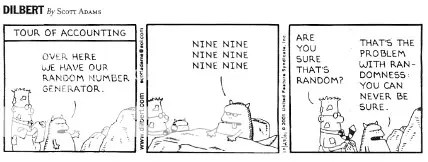
If you have an iPod, you’ve had those moments where you suspect that the “shuffle” feature isn’t as random as it’s supposed to be– why else would it play three songs in a row from the 1980s that all feature former Beatles? But, as this NPR report and this episode of WGBH’s Open Source make pretty clear, it’s not that the iPod isn’t random– it’s that our minds are quite bad at perceiving randomness. We naturally and instinctively look for order, for patterns, and our mind gloms onto them instantly, even if what we’re really looking at is completely random…

Even in the face of chaos, our brains look for order, looking for connections, perceiving causality. And that process is a lot of what we as historians do– we look to the chaos of the past, and try to make order of it. Sometimes we do it by imposing our own frameworks onto the events of the past, but we at least like to think that what we are actually doing is illuminating connections that may have been obscured, perceiving the organic order where it may look like chaos or disorder.

So how do we harness this propensity to see order, and make it work for us?

* * *

It seems to me that randomness has traditionally been a bit of an anathema to historians. The sheer vastness of history itself requires the imposition of order, and that’s the historian’s task. “Doing history” is making order out of disorder. Why would we embrace the chaos?

But digital tools allow us to work with things differently. This started to be apparent with the New Social History, with historians working with punch-card computers to crunch number sets so vast that they had been useless before. Computers are great for making large data sets manageable.

They’re also quite good as pseudorandom number generators, which in turn means that they are quite good at creating fairly random juxtapositions. We can see this with the iPod’s shuffle feature, or even the link on Wikipedia that takes you to a random page. We now find ourselves in a age of shuffle, where wild juxtaposition is the norm.

Even simple little applications like the Random Activity Generator can be powerful tools for promoting creative thinking. Incorporating the principle of randomness into tools for digital humanists would, I think, help promote better scholarship. Shuffling– creating random juxtapositions– forces the mind to make connections between otherwise unconnected items. And finding new connections between historical events– isn’t that at the heart of a historian’s work?

Categories
Uncategorized

Melville and Visualization

Something from the attic, if you will– a post from four months ago that never got finished and sat around in draft limbo. I’m going to spend the next week or so emptying out that attic and getting the half-finished stuff out there and published, even if it’s not perfect.
* * *

I was talking to a friend of mine, a Melville scholar, about Bartleby the Scrivener a while back, and the first thing he told me was, “You have to remember– it’s not about about Bartleby.”

I thought back to the Wordle visualization of Moby Dick I posted a while back, went to Project Gutenberg, and decided to check out what Wordle thought of this theory.

Apparently, Wordle would disagree:

Wordle: Bartleby the Scrivener

Now, I understand what my friend was arguing– that it’s actually about the narrator, the lawyer, and his reaction to Bartleby. But I disagree. Or at least, I think it’s a bit reductionist. At its heart, the story is about Bartleby, even if it’s about him as an enigma. He’s at the center of the text, and from the above, it shows that this is at the very least the case numerically.

You have to wonder about whether this is just another case of the phenomenon that Dan Cohen discussed a while back about the limits of the possibilities of text mining– basically, that if you don’t ask the right questions about a text, you end up finding out that the Bible is a book about Jesus and that War & Peace is a book about Russia.

Is Wordle too simple a tool to help us really rethink or explore a text? Does it really only offer the simplistic answers? Was I using it as a crutch for my overly-simplistic reading of the story when I saw it as endorsing my feeling that a story that uses the name Bartleby that many times has to be at least somewhat about Bartleby?

So I went to another shorter work by Melville– Benito Cereno.

Wordle: Benito Cereno

Again, proper names dominate– the large incidence of “Benito,” “Delano,” and “Babo,” not to mention the titles of “Captain” and “Don,” should come as no surprise to anyone who’s read the novella. Likewise, in this tale of a slave insurrection, the commonness of terms like “Negro,” “Negroes,” “Blacks,” “servant,” and “master” is not surprising.

However, where I noticed the frequency of use of terms that indicated the race of the rebelling slaves, the frequency of terms indicating the “Spanish” origin of the San Dominick’s crew surprised me– if combined, “Spanierd” and “Spanish” would be approximately the size of “Negro.” This actually ended up shifting my reading of the story.

The entire story works on the tension created by Captain Delano’s inability to parse what was going on on the San Dominick. He is constantly shifting views, sensing something sinister and then convincing himself that nothing outside the ordinary was occurring. That the inscrutability of the events is in part due to his perceiving the African slaves as deeply other is obvious– he is constantly shifting around in the deep illogic of racism, seeing the slaves as alternatively threatening and deeply dependent.

But there’s something else going on here, too. The New England-born Delano is likewise confused by the ethnic otherness of the San Dominick’s “Spanish” crew. These men are almost as othered to him as the slaves are– a deep divide that creates an inscrutable situation. If the crew had been from New England, Delano would have surely sensed that an insurrection was occurring. But with the strange cultural difference of a crew from the southern hemisphere, he could not be sure. These people had different ways of interacting with blacks than they had in New England, the racial hierarchies– might they not be a little less distinct down there?

One senses that the drama of the situation partially comes from Delano’s ethnic ambivalence– his own sense that the crew of this ship might not be completely “white” themselves. Spanish-ness is just as much a part of the tensions of the book as blackness and whiteness.

This isn’t the most sophisticated reading in the world of the novella, and it may seem patently obvious to someone else. But to me, it came as a revelation. In this case, a simple tool like Wordle was just enough to make me reframe my reading, look sideways at a text that I might not have given quite as much thought to.

The most simple visualization tools can provide some very basic information, but sometimes even that is enough to make you reconsider a text that had previously seemed uncomplicated. Even when they provide painfully obvious answers, there might be other interesting nuggets in those results– you just have to look and sift around a bit.

Categories
Uncategorized

Economics and Annoying Smart Guys

This pretty much reflects exactly how I feel about the current economic situation.

Categories
Uncategorized

The Concept of the “Work Ukulele”

I have a work ukulele.

I bought it specifically to keep here at CHNM. It’s a Makala MK-S, a glossy black soprano with a goofy little dolphin bridge. They run less than forty dollars. With some Aquila strings, they really sound pretty good for a super-budget ukulele.

I think having a work uke is a great idea, and anyone who plays ukulele should definitely go out and get one. The work uke has several advantages: it means that you play outside of your typical comfort zone– in my case, this means playing anywhere but my living room, bed room, or my stoop. It also invites others to play. This is my little bit of stealth ukuelele evangelism. People who may have experience with guitars or other stringed instruments will stop by my little area of the lab, pick it up, and play around on it a bit. I’m hoping to get a ukulele convert or two out of this office.

Finally, the ultimate benefit of the work uke is that it’s great for getting things unstuck. When I’m just not able to figure out a problem, a couple verses of Five Foot Two are a great way to jump-start the brain, get things moving again. They say that music has a profound impact on the brain, and some have argued that it enhances creativity. Or maybe it’s just the same “distraction effect” that so many people have experienced, where you get your best ideas when you walk away from a project for a moment, having profound realizations about your work while showering, having a smoke, or making a peanut butter sandwich.

So– uke players of the world– and even non-ukers who may want to learn– go out and get a work ukulele. And tell your boss it’s only making you a more productive, more creative worker!

My "Work Uke"

Categories
Uncategorized

Asus Eee PC 901 Review

I know there’s already about a million Eee PC reviews out there, but several of my Facebook and Twitter friends have asked me to take a minute to talk about my newest toy, an Asus Eee PC 901… So for the first time ever, I can claim to be writing a post “by popular demand.”

It occurred to me today that it might be almost predictable that I would like the Eee PC– it’s basically the ukulele of laptops. It’s small, portable, fun, and when you pull one out in front of people, their responses are usually either astonishment or amusement. It’s just so tiny! Some images to try to give a sense of scale:

Asus eee 901This is my Eee atop my 17″ Toshiba laptop, along with a pack of Bicycle playing cards. As you can tell, my Toshiba could eat my Eee. This is, of course, the entire point of the Eee. Weighing less than than two and a half pounds and only nine inches wide, the thing is extremely portable. It’s about the size of a leather-bound day planner.

Asus eee 901While its small size is the chief selling point of the Eee PC, it’s also one of its drawbacks. I’ve seen many reviews that say the keyboard is simply too small for an adult male. There’s some truth to this, but I take issue at the same time. I have to take this back to the ukulele comparison, here. It’s a reoccurring issue for beginners on ukuleles– the belief that having large fingers will make it impossible to play a small soprano uke. However, this just isn’t true. Once your fingers learn where to go, you can play the smaller uke. If a man the size of Israel Kamakawiwo’ole can play the ukulele, size is no excuse.

That said, I wouldn’t chose my Eee as my computer of choice for writing a seminar paper or writing a CSS style sheet from scratch. The smaller size makes touch-typing much more difficult, especially if you’re going to be (as I assume most users will) switching back and forth between it and regular-sized keyboards. The smaller keys do mean a few more slips of the fingers, and the compressed size also means making some sacrifices or compromises. The biggest example of this is the right shift key, which is the same size as (and directly to the left of) the up arrow– and this can create some very inconvenient typos.

Overall, though, I’m very happy with the purchase. This computer fits my needs– it was under five hundred dollars, it fits (with plenty of room for chords, a book or two, pens, etc.) in my man-purse, and the solid-state hard drive eases my mind about the occasional bump or thump it might get as I carry it around. It’s the perfect size to strap on my back and bike to class, to take to meetings or trips to libraries or archives. 20 gigs of memory isn’t the most, but it’s plenty for a secondary computer that you use primarily for webaps. (And the fact that it comes with an equal amount of online storage is awesome.)

Asus eee 901And it’s wicked fast. Like, seriously fast. Puts my theoretically much better main laptop to shame. In the default “easy mode” (pictured at left) it boots impossibly fast– a matter of seconds, and does it almost silently, too. The tabbed system of the easy mode is super-intuitive and simple– it looks almost like a toy or a computer that your grandmother could understand. But it’s slightly buggy, occasionally and inexplicably losing an icon. And on top of that, it doesn’t take full advantage of the KDE/Xandros Linux machine you’ve purchased. There’s not even an icon for the terminal window or Konqueror (two of the more powerful pieces of software on the thing, really…) in easy mode.

Asus eee 901I bought the Linux machine– you can purchase it with Windows XP if you’re more comfortable with that– for a reason. I’m not a huge fan of Leopard or Vista, and I knew that this means I’m going to want to start learning Linux. This is where the Advanced Desktop Mode (which you can see to the right) comes in.

At first I was confused why the folks at Asus didn’t just include the full desktop mode on the computer as a default– anyone who’s going to be buying a Linux-powered mini web machine like this is going to want to take full geeky advantage of it. But once I worked up the nerve to go under the hood, I found that it wasn’t that hard to install (although there is a little extra script editing for the 900 series due to a conflict that I don’t really understand as a Linux newbie). And the process of installing and activating the desktop got me (as an absolute beginner) familiar with some of the more important programs– the terminal window, Synaptic, and Kate. I feel more empowered and encouraged to look into expanding and altering the thing now that I understand how to get around, and have seen some basic commands in action.

Next step: upgrading to Openoffice 3, installing XAMP, and finding a good compatible Twitter client.

Overall, for the price, this thing can’t be matched. I’ve played around with the MacBook Air, and while it’s got more memory and power, it felt like it was going to snap in my hands. Plus, it costs three or four times as much and takes up more room in a bag. I’d recommend it to anyone who wants a small, portable laptop. If you’re like me, and do ninety percent of your work online, anyway, the relatively small memory shouldn’t be a problem. The battery life isn’t the stuff of dreams, but it’s probably the longest of any laptop I’ve had. You’re not going to write your dissertation or your novel on this thing, but I imagine it’d be a lifesaver on research trips or conferences.

css.php